Agentic AI and the Evolving SDLC: Orchestrating Autonomous Engineering
The world of software development has always been a dynamic one, constantly reshaped by new tools and methodologies. For years, we've integrated AI in various forms, from static analysis tools to increasingly capable code completion engines. Yet, what we're witnessing now with the rise of agentic AI is fundamentally different—it's not just augmenting our work; it's restructuring the very fabric of how we build.
The Echoes of Manual Mastery
Many of us remember the pre-copilot days, a time when solving a complex bug often meant a deep, multi-day dive into obscure documentation, forum rabbit holes, and countless compiler errors. There was a unique satisfaction in painstakingly unraveling a tough problem, the intellectual journey almost as rewarding as the destination. This 'long way round' fostered a profound sense of ownership and deep system understanding.
Fast forward to today, and AI copilots have become an indispensable part of many developers' toolkits. They offer a significant leap in output, making quick work of boilerplate and offering helpful suggestions. While they maintain a sense of human ownership over the final code, the reliance on these tools has become profound. Recent industry studies indicate a striking trend: a significant percentage of developers are increasingly unwilling to undertake tasks without AI assistance. This isn't merely a preference; it signals a step change in how software is perceived and built, shifting our cognitive load away from pure syntax towards higher-level problem framing.
Agentic AI: The Structural Difference
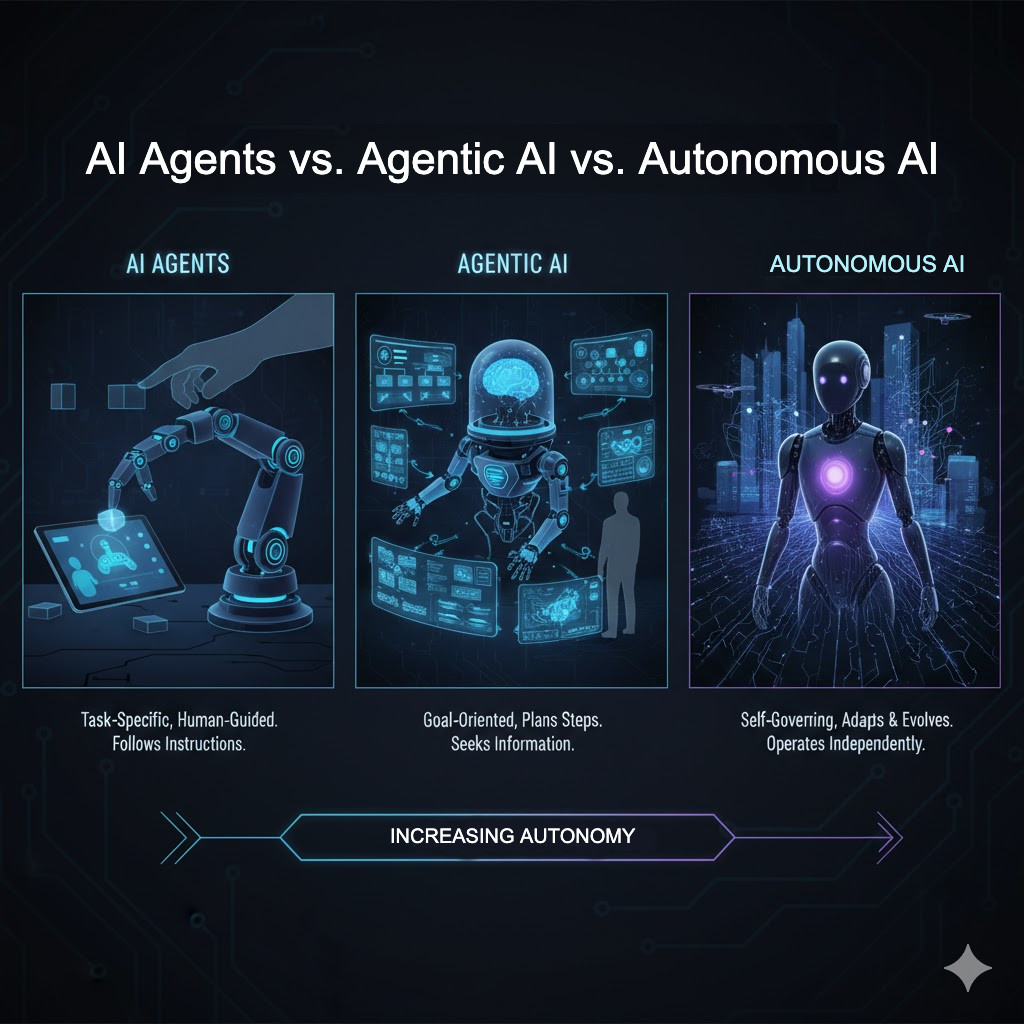
While copilots assist, agentic AI operates on a different plane. Think of the difference between driving a car with advanced cruise control and riding in a fully autonomous vehicle. With the former, you're still actively driving, making most decisions. With the latter, you set the destination, and the vehicle handles the intricate steps of navigation, obstacle avoidance, and dynamic routing.
Agentic AI systems move beyond simple prompt-response interactions. They are designed to reason, plan, and pursue complex, multi-step goals autonomously, often across extended periods. This 'sustained execution' is the core differentiator. These agents can invoke external tools, interpret results, and iterate on their approach, mimicking a human problem-solving loop. The focus shifts from us providing explicit code instructions to defining high-level objectives and constraints, allowing the agents to determine the specific execution path.
The Nuance of Productivity Gains
The initial wave of AI integration brought a 'productivity paradox.' Some early studies, particularly involving experienced open-source developers, even observed that tasks with AI tools took slightly longer. This was often attributed to the overhead of directing, reviewing, and correcting AI-generated output. It's a valid point: integrating new tools always introduces a learning curve and new forms of cognitive friction.
However, a subsequent trend emerged rapidly: developers increasingly expressed a reluctance to work without AI. This suggests that while initial adoption might introduce some friction, the underlying value proposition is compelling enough to become a default expectation. The real lesson here is that AI productivity gains are highly task-dependent and context-dependent. They only truly materialize when teams establish appropriate workflow structures around these advanced tools. Simply using autocomplete more often, as one study found, doesn't translate to organizational velocity gains. Deep integration requires a fundamental rethink of processes.
SDLC Reimagined: Autonomous First-Pass Execution
The most immediate and tangible impact of agentic AI is on development velocity and the overall Software Development Lifecycle (SDLC). We're moving beyond AI as a sophisticated coding assistant to AI as an autonomous, multi-skilled team member capable of acting as a 'first-pass executor' across various SDLC phases:
Planning & Feasibility: Agents can analyze requirements, assess architectural implications, and even generate preliminary design options.
Implementation: Beyond boilerplate, agents can scaffold entire features, generate substantial portions of code, and integrate disparate components.
Validation & Testing: They can expand test coverage, generate edge cases, surface potential defects early, and even write comprehensive test suites.
Review & Documentation: Agents can identify risks, suggest refactorings, and generate initial documentation drafts, freeing human engineers from tedious context gathering.
This capability compresses what once took weeks of coordination and handoffs into continuous, iterative workflows. The result isn't just faster delivery; it's a reduction in operating costs and a more efficient allocation of talent. The deeper gain is 'cognitive leverage'—fewer context switches, less rediscovery of system knowledge, and more time for human engineers to operate at a higher level of abstraction.
The Engineer's New Mandate: Orchestration and Oversight
This shift necessitates a fundamental redefinition of engineering roles. We are transitioning from primary 'creators' to sophisticated 'curators' and 'orchestrators.' The engineer of this new era will spend less time on foundational code syntax and more time designing the overarching system architecture, defining precise objectives and guardrails for AI agents, and rigorously validating the final outputs. The core skill set evolves from simply writing correct code to mastering systems thinking, risk assessment, and strategic oversight.
Leading teams are converging on a clear operating model: delegate, review, and own.
- Delegate: AI agents handle the first-pass execution, code generation, testing, and initial documentation.
Review: Human engineers critically examine agent outputs for correctness, security, performance, and alignment with business goals. This includes identifying subtle errors or suboptimal approaches that an agent might miss.
- Own: Ownership of the architecture, critical trade-offs, and ultimate outcomes remains firmly with the human engineers. This clarity ensures that accountability scales with autonomy.
This model allows autonomy to scale without diluting human responsibility, channeling our unique creative and strategic problem-solving capabilities toward the most impactful challenges.
The Path Forward
The shift to agentic AI is not just about adopting new tools; it's about a strategic overhaul of people, processes, and platforms. Organizations that thrive will be those that deliberately design for this new reality. It means investing in robust agent orchestration capabilities, developing clear guidelines for agent interaction, and, crucially, fostering a culture where engineers are empowered to embrace their new roles as orchestrators of intelligent systems. The goal isn't to replace human engineers, but to elevate them, freeing them from the repetitive to focus on the truly innovative and complex problems that still require our unique blend of creativity and strategic insight.