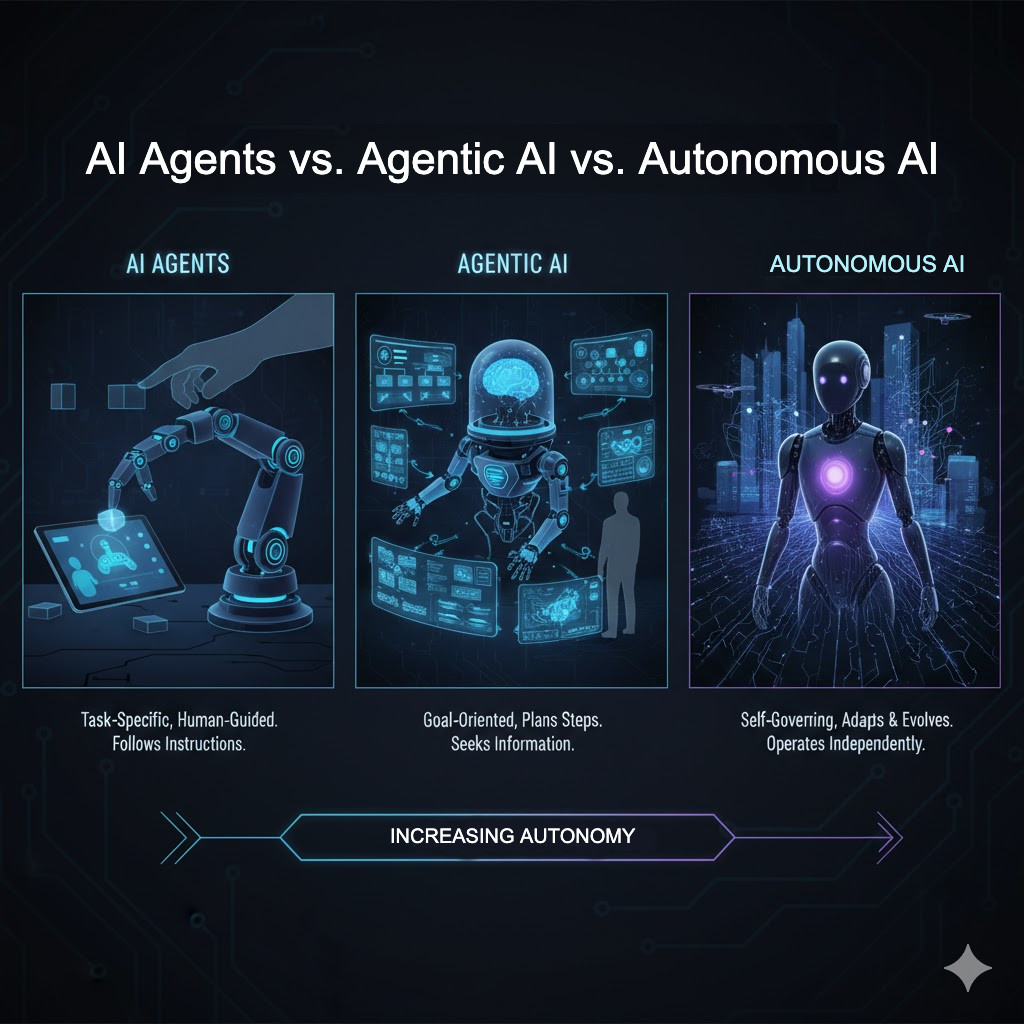
Agentic AI: Crafting Autonomous Systems Beyond Reactive Logic
The conversation around AI is rapidly evolving. For years, we've built systems that respond to prompts, classify data, or automate rule-based workflows. These are powerful, but largely reactive. Now, we're entering an era where AI takes the initiative, where systems are not just smart, but genuinely autonomous. This is the domain of Agentic AI and autonomous agents, a paradigm that is quickly moving from experimental curiosity to mainstream production by 2026.
As developers, understanding this shift is crucial. We're no longer just instructing algorithms; we're designing entities capable of independent thought and action. An AI agent is fundamentally a system or program that can autonomously perform tasks on behalf of a user or another system. What sets it apart is its ability to design its own workflow, utilize available tools, and operate with a meaningful degree of autonomy, making decisions and solving problems without requiring human approval at every step.
The Autonomy Imperative: Beyond Static Responses
Traditional AI often feels like a highly sophisticated vending machine: input a command, get a predefined output. Agentic AI shatters this model. These systems don't just follow instructions; they plan, reason, adapt, and learn from their environment. Think of them as systems with an internal compass, continuously orienting themselves toward a defined objective.
- The core of this autonomy lies in a continuous operational loop. While terminology may vary, the underlying sequence is consistent:
- Perception: The agent observes its environment, gathering relevant information.
- Reasoning: Based on its goal, current state, and memory, the agent processes this information and determines the best course of action.
- Planning: It devises a multi-step strategy to achieve its objective.
- Action: The agent executes steps of its plan, interacting with the real world through various tools.
- Observation: It perceives the results of its actions, noting any changes in the environment.
- Memory Update: The agent integrates new information and experiences into its knowledge base.
This loop isn't a fixed script; it's a dynamic cycle. The agent will continue this process until its goal is achieved, a predefined stopping condition is met, or it determines it requires human intervention.
Dissecting Agentic Intelligence: Components of Autonomy
What precisely gives an agent this capacity for independent operation? It's a combination of interconnected components:
Perception: This isn't just about parsing text. It's about interpreting diverse data streams – sensor inputs, database queries, web content, user requests – to build a comprehensive understanding of its environment.
Reasoning and Decision-Making: This is where the 'intelligence' shines. Agents determine what to do next based on their understanding of the world, their goal, and their accumulated memory. They select between options rather than blindly following a predefined flow. This involves complex problem-solving and dynamic adaptation.
Memory: Crucial for sustained autonomy, memory allows agents to track progress, recall past interactions, and learn from experiences. It's more than just a chat history; it's a dynamic knowledge base influencing future decisions.
Tool-Based Actions: This is perhaps the most significant differentiator from a mere chatbot. Agents aren't limited to generating text. They interact with the real world by utilizing external tools: performing web searches, executing code, calling APIs, manipulating file systems, or navigating user interfaces. This enables them to have real effects and complete tangible tasks.
An AI agent is definitively not just a chatbot with memory. It's not a standard API integration or a simple rule-based automation. The agent property emerges from the infrastructure that provides these components, enabling the model to operate in a continuous action-observation loop.
Architecting for Agency: Frameworks and Multi-Agent Systems
Building robust AI agents requires a solid foundation. This is where agentic architectures and frameworks come into play. An agentic architecture defines the structure and design of these systems, shaping how workflows are automated. Agentic frameworks are the foundational building blocks – software platforms that streamline the development, deployment, and management of AI agents by offering built-in features for orchestration, tool integration, and memory management.
For more complex objectives, multi-agent systems are proving invaluable. Instead of a single monolithic agent tackling an enormous task, multi-agent systems consist of multiple specialized AI agents working collectively. This distributed approach allows for faster execution, greater capability, and often more robust solutions, as tasks can be broken down and managed concurrently by agents optimized for specific sub-problems.
One particularly promising application is Agentic RAG (Retrieval Augmented Generation). While traditional RAG systems augment Large Language Models (LLMs) with external knowledge, agentic RAG takes it further. Agents facilitate information retrieval from multiple, diverse sources, handling more complex workflows and dynamic information gathering, leading to more accurate and comprehensive LLM outputs.
Beyond the Hype: Practical Applications and Real Risks
Agentic AI is no longer a theoretical exercise; it's actively being deployed across various industries. From customer service and human resources to sales, procurement, finance (e.g., automatically adjusting investment strategies), healthcare, and software engineering, agents are tackling repetitive, multi-step workflows. Think of agents that research market trends, manage project sprints, or even troubleshoot software issues.
However, a pragmatic developer knows that power comes with responsibility and inherent risks. Key concerns include:
Hallucinations: Agents, particularly those leveraging LLMs, can still generate inaccurate or nonsensical information.
Tool Misuse: An agent with broad tool access could inadvertently or maliciously perform unintended actions.
Prompt Injection: Adversarial inputs could manipulate an agent's behavior or objectives.
Cascading Failures: In multi-agent systems, an error in one agent's output could trigger a chain of incorrect actions across the entire system.
This necessitates robust AI agent governance. Good deployments enforce least-privilege permissions, maintain full action logging for auditability, require human approval for high-risk tasks, and implement kill switches to halt runaway processes. The evolving regulatory landscape around AI agents further underscores the need for robust ethical frameworks and safety guardrails.
The Developer's Path to Agentic Mastery
For developers looking to engage with agentic AI, a clear roadmap emerges. It begins with solid foundational skills:
- Core Mathematics: A grasp of linear algebra, calculus (derivatives, gradients), probability, and statistics provides the bedrock for understanding underlying ML models.
Programming Proficiency: Python remains the recommended language, coupled with essential libraries like Pandas, Matplotlib, and NumPy for data manipulation and visualization.
- Machine Learning Foundations: Understanding supervised, unsupervised, and reinforcement learning concepts is vital, as agents often combine these approaches.
Beyond these fundamentals, mastery involves understanding agentic architectures, familiarizing yourself with various agentic frameworks, and learning design patterns for orchestrating single and multi-agent systems. The focus shifts from merely calling an API to designing intelligent systems that can perceive, plan, and execute within defined boundaries, all while ensuring safety and ethical deployment.
Agentic AI represents a significant leap in automation and intelligent systems. It's not just about making existing processes marginally better; it's about enabling entirely new capabilities for software. As developers, our role is to embrace this change, understanding its profound potential while responsibly navigating its complexities and inherent risks. The future of computing, driven by autonomous agents, is here, and it demands careful, skilled engineering.