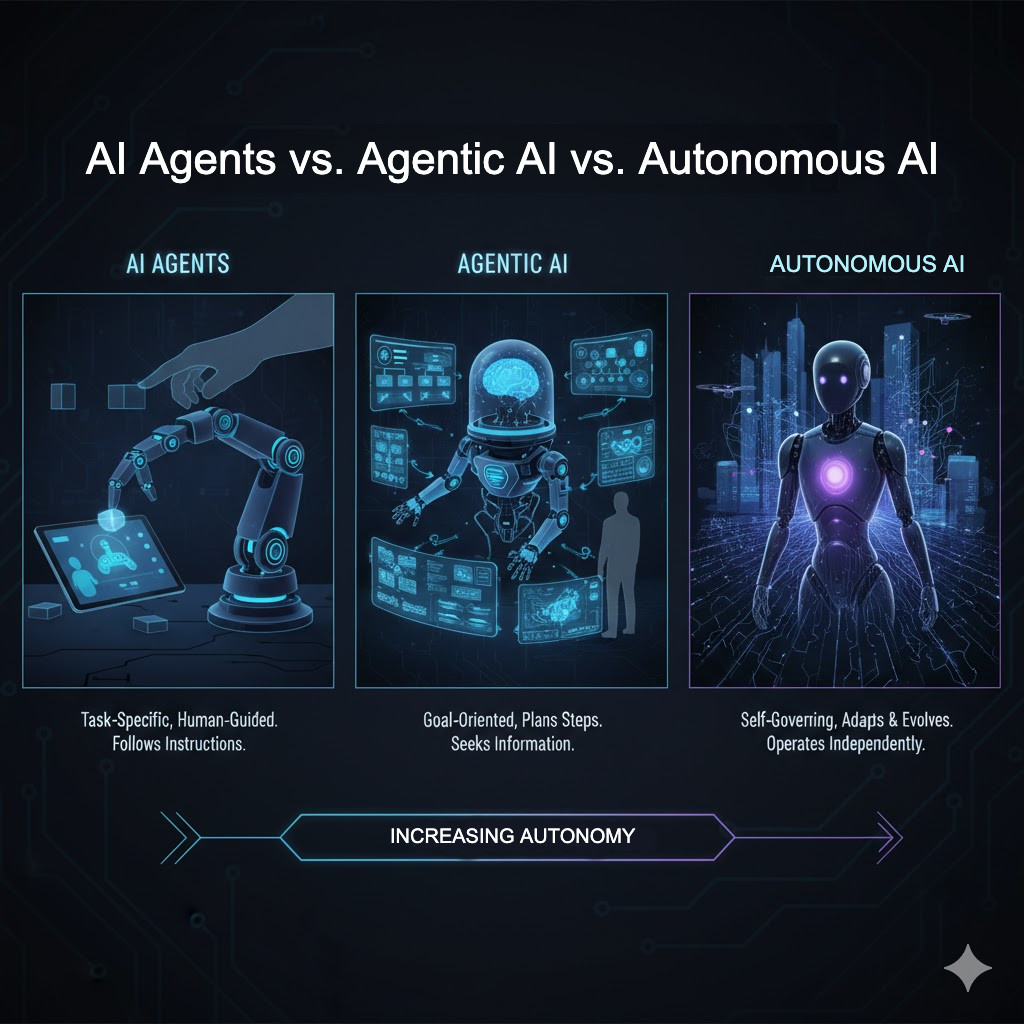
Agentic AI: Evolving Beyond Reactive Systems for Autonomous Software
The landscape of artificial intelligence is consistently shifting, and a significant evolution is underway, moving us beyond the familiar territory of reactive AI systems. We're witnessing the rise of agentic AI and autonomous agents – systems designed not just to respond to commands, but to proactively plan, make decisions, execute tasks, and learn from their environment to achieve complex goals.
For developers, this isn't merely an incremental update; it represents a fundamental change in how we conceive, design, and interact with AI-powered applications. The days of single-prompt interactions are giving way to long-running, goal-driven software that possesses a degree of agency, enabling it to operate with increasing independence.
What Defines an AI Agent?
At its core, an artificial intelligence agent is a system or program capable of autonomously performing tasks on behalf of a user or another system. Unlike a traditional chatbot that requires continuous user input to drive its operations, an AI agent can design its own workflow and intelligently utilize available tools to reach a specified objective. This encompasses a broad spectrum of functionalities that extend far beyond natural language processing, including sophisticated decision-making, problem-solving, interaction with external environments, and the execution of actions.
What truly distinguishes an AI agent is its capacity for initiative. These systems don't merely follow instructions; they plan, reason, and adapt to new situations by learning from their experiences. Consider an agent managing financial investments, capable of automatically adjusting portfolios based on market data, or a research agent independently exploring scientific literature and suggesting experiments.
AI agents typically operate based on a foundational Perceive, Reason, Act, Reflect (PRAR) cycle:
Perceive: The agent observes its environment, taking in user input, system state, available tools, and historical memory to comprehend the current context and task constraints.
Reason: Leveraging a large language model (LLM) or hybrid logic, the agent plans its approach, makes strategic decisions, and selects appropriate actions.
Act: The agent executes these chosen actions, which might involve calling external APIs, updating its internal memory, or triggering subsequent workflows.
Reflect: Critically, the agent evaluates the outcome of its previous actions, learns from successes and failures, and adjusts future decisions, plans, or prompts to improve overall results. This iterative learning is key to its autonomy and increasing efficacy.
Architecting Autonomy: The Role of Agentic Frameworks
Building robust, scalable AI agents from scratch is a formidable task. This is where agentic frameworks become indispensable. These software platforms serve as the foundational building blocks for developing, deploying, and managing AI agents at scale, offering built-in features and functions that significantly streamline and accelerate the development process.
An agentic architecture refers to the structure and design principles underlying these frameworks. It dictates how AI models are automated within an agentic system, shaping the overall workflow. Most modern frameworks provide three core capabilities essential for agent functionality:
Orchestration: This component controls how agents are sequenced, coordinated, and allowed to collaborate. It's the conductor of the agentic symphony, ensuring tasks are performed in the correct order and interactions between agents are managed effectively.
Tools: Agents gain power through their ability to interact with external systems. Frameworks provide mechanisms to define and integrate these tools, whether they are APIs, databases, or other software utilities.
Memory: For an agent to learn and adapt across steps or sessions, it needs to retain and retrieve information. Frameworks manage this memory, providing context and continuity to an agent's operations.
While technically possible to construct an agent without a dedicated framework, these toolkits are vital for achieving reliability, scalability, and safety, especially as agentic systems become more complex. They facilitate critical aspects like:
Multi-agent coordination: Enabling multiple agents to communicate, plan together, and specialize in different aspects of a larger task.
Human-in-the-loop (HITL) checkpoints: Intentional pause points where human oversight can review an agent's proposed actions before execution, adding a crucial layer of control and safety.
Observability, control, and reproducibility: Providing developers with the ability to monitor an agent's activities, guide its behavior, and ensure consistent results when tasks are re-run.
Frameworks like LangChain and AutoGen have rapidly gained prominence, underscoring the growing developer reliance on these infrastructures to manage the intricate reasoning, memory, and tool integration required for autonomous systems.
The Power of Collaboration: Multi-Agent Systems
The true potential of agentic AI often emerges when multiple agents work collectively. A multi-agent system consists of several AI agents collaborating to perform tasks on behalf of a user or another system. This collaboration allows for the tackling of far more complex problems than a single agent could manage.
Consider Agentic RAG (Retrieval Augmented Generation) as a practical example. While traditional RAG systems augment Large Language Models (LLMs) with retrieved information, agentic RAG takes this a step further. AI agents facilitate the retrieval process, allowing LLMs to conduct information retrieval from multiple, diverse sources and handle significantly more complex, multi-step workflows. This means an agent can intelligently decide which sources to query, how to phrase the query, and how to synthesize information from disparate results, dramatically improving the accuracy and depth of responses.
Practicalities and the Road Ahead
As developers, embracing agentic AI means acknowledging both its transformative potential and the practical challenges involved. A critical consideration is AI agent governance, which encompasses the processes, standards, and guardrails necessary to ensure these autonomous systems operate safely and ethically. As regulations evolve, robust governance frameworks are becoming increasingly essential.
Building effective agentic systems also necessitates a solid grounding in core technical disciplines. While frameworks abstract much of the complexity, a fundamental understanding of machine learning concepts, alongside mathematical foundations like linear algebra, calculus, probability, and proficiency in programming languages like Python, remains invaluable for deeper engagement and debugging.
The industry consensus points to agentic AI becoming mainstream by 2026. This shift implies a growing demand for developers who can leverage these systems to boost productivity and drive enterprise transformation. From customer service and human resources to sales and procurement, the application possibilities are vast. However, scaling agentic AI for measurable ROI across an enterprise requires careful planning, addressing potential barriers, and adopting a practical framework for successful, widespread adoption.
For us, the challenge and opportunity lie in moving beyond experimental builds to maintainable, observable, and controllable agentic software. The future of computing is increasingly intertwined with these autonomous entities, and understanding their architecture, capabilities, and the frameworks that power them is no longer optional—it's foundational for developing the next generation of intelligent applications.