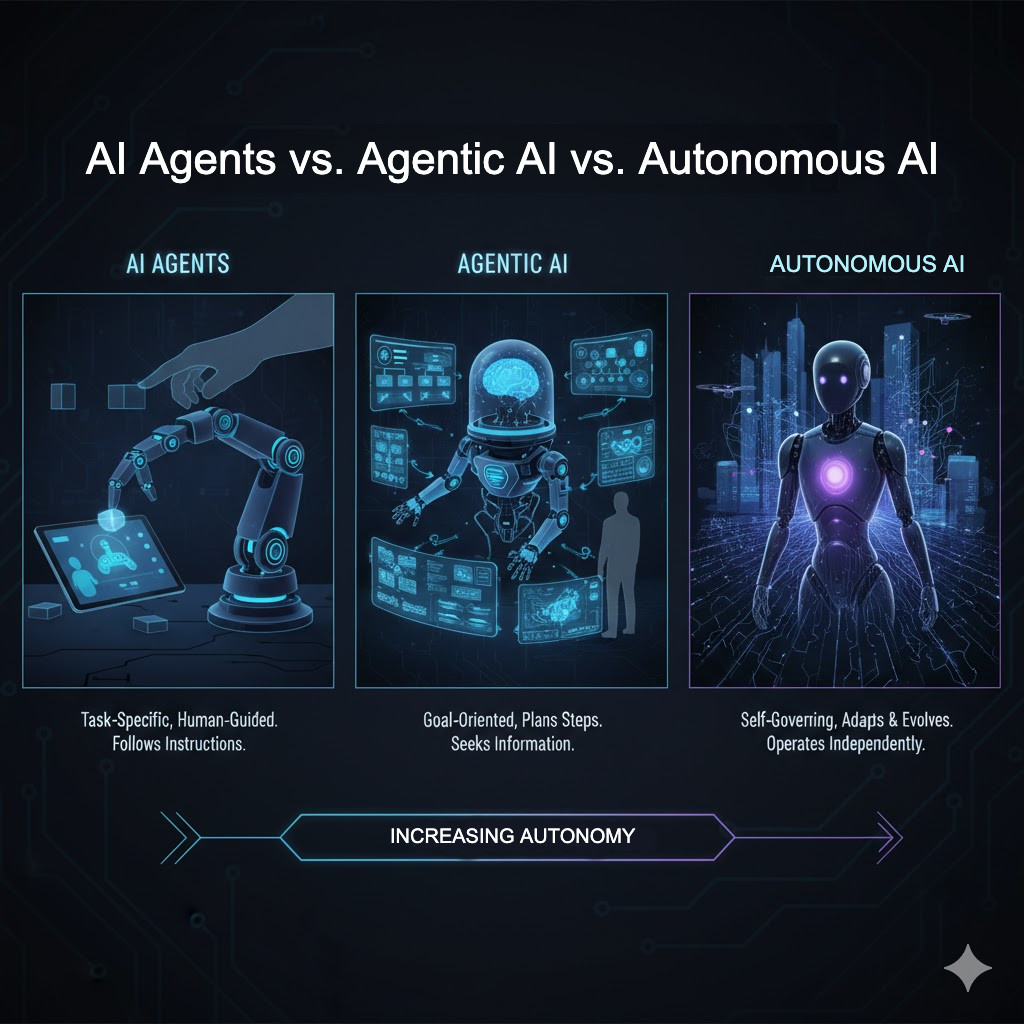
Agentic AI: Navigating the Autonomy Frontier
Artificial intelligence has been on a rapid evolutionary trajectory. We've moved from predictive models that forecast outcomes to generative AI, which crafts novel content from text to images. Now, the discourse has firmly shifted to agentic AI, or autonomous AI agents – systems designed to make decisions and execute actions in dynamic environments without requiring constant human oversight.
For many of us, the genAI 1.0 era, characterized by large language models (LLMs) like ChatGPT, has become a staple for automating rote tasks: summarizing documents, analyzing data, or drafting initial content. These are powerful tools, certainly, but they are primarily reactive; they respond to direct prompts. Agentic AI, however, heralds what some are calling genAI 2.0, a paradigm where AI systems possess agency – they proactively plan, execute multi-step tasks, and adapt to changing conditions to achieve higher-level goals.
The Core Principles of Agentic Systems
What truly distinguishes agentic AI from its predecessors are a few fundamental characteristics:
#### Autonomy
At the heart of agentic AI is the capacity for autonomous operation. Unlike traditional software that strictly adheres to predefined rules or even earlier AI that waits for step-by-step instructions, an agentic system, once given a high-level objective, determines its own course of action and carries it out. It decides which actions to take and when to take them to meet its goals, without a human hand-holding it through each micro-step. This independence isn't just about speed; it’s about the system itself having the agency to make informed decisions.
#### Adaptability
Agentic AI agents are not static. They are designed to learn from interactions, feedback, and their environment. This means they can improve their performance over time and adjust to unforeseen situations. Instead of being bound by a fixed set of hard-coded rules, agentic systems leverage probabilistic models and continuous learning. This allows them to respond intelligently to dynamic environments and unique, domain-specific scenarios, handling complexities that might stump a rigid, rule-based system.
#### Goal-Directed Behavior
Proactivity is a hallmark of agentic AI. These systems don't just react to triggers; they anticipate needs, identify emerging patterns, and take initiative to address potential issues before they escalate. Their behavior is driven by an awareness of their environment and an ongoing evaluation of their actions against long-term goals. For example, in a supply chain context, an agentic system wouldn't just update delivery statuses; it could monitor inventory, track weather, anticipate delays, proactively reroute shipments, and alert stakeholders, all to meet a core delivery objective.
Beyond the Chatbot: The Agentic Workflow
The move from a conversational interface to an autonomous agent marks a significant architectural shift. While LLMs provide the reasoning backbone, agentic systems augment them with capabilities for memory, planning, and crucially, tool use. These agents can interface with other software systems via APIs, perform economic transactions, and interact with the broader internet. This enables them to execute multi-step plans that span various digital environments.
Consider a seemingly simple task like planning a vacation. A generative AI might suggest destinations. An agentic AI, given a budget and preferences, could autonomously research flights and hotels across different platforms, compare prices, check availability, read reviews, coordinate with a calendar, and even book and pay for services – all while adapting if a preferred flight gets cancelled or a hotel becomes unavailable. This is a multi-step loop, requiring planning, execution, and continuous re-evaluation.
Architectural Implications: Hyperspecialization and Orchestration
Many robust agentic AI implementations aren't monolithic. Instead, they often build upon multiple hyperspecialized agents, each focused on a narrow area of expertise. These individual agents then coordinate, share insights, and hand off tasks as needed. In a financial services context, for instance, one agent might specialize in regulatory compliance, another in fraud detection, and a third in portfolio optimization. Together, they form a cohesive system capable of real-time transaction monitoring, anomaly flagging, and investment recommendations, all while adhering to complex regulations.
This architecture necessitates robust real-time data infrastructure and distributed systems. Agents need to perceive, reason, and act based on the most current information, and their collaborative nature demands efficient inter-agent communication and state management. Without a solid data foundation, the adaptability and proactivity of these systems are severely hampered.
Practical Applications and Developer Utility
The potential for agentic AI to enhance developer productivity and drive business value is substantial. We're seeing early examples in areas such as:
Automated Workflow Orchestration: Streamlining complex, inter-departmental processes from HR to logistics.
Proactive System Monitoring: Identifying and addressing potential issues in IT infrastructure before they impact users.
Personalized Digital Assistants: Going beyond simple queries to managing schedules, communications, and project tasks.
Healthcare: Coordinating treatment plans, optimizing schedules, and providing context-aware support while complying with regulations.
Software Engineering: Potentially assisting with code generation, testing, deployment, and even refactoring based on observed system behavior and performance metrics.
The promise is that these systems can free developers and other professionals from repetitive, multi-step tasks, allowing them to focus on higher-order problems requiring human creativity and critical thinking.
Navigating the Hype: Challenges and Critical Considerations
While the industry buzz around agentic AI is undeniable, a pragmatic developer knows that new frontiers come with significant challenges. There's a fine line between genuine innovation and mere hype. Many so-called 'AI agents' currently amount to little more than wrappers around existing LLMs or sophisticated Zapier-like automation flows. True agentic capability – encompassing autonomous decision-making, genuine adaptability, and complex goal pursuit – is a much harder problem to crack.
Organizations adopting agentic AI face critical issues:
- Data Quality and Governance: Agents operate on data. Poor data quality, biases, or inadequate governance frameworks can lead to flawed decisions and unpredictable behavior.
Trust and Security: Granting AI systems autonomy requires immense trust. Ensuring these systems operate securely, respect privacy, and have robust safeguards against unintended actions is paramount.
Interpretability and Control: Understanding why an agent made a particular decision or took a specific action can be challenging. Developers need mechanisms for oversight, intervention, and debugging.
- Strategy and Risk Management: Deploying agents at scale without a clear strategy, a thorough understanding of their capabilities, and a robust risk management framework is a recipe for trouble. The societal implications are still largely nascent, and organizations are still learning how to maximize their productivity.
The Road Ahead
Agentic AI isn't just a fascinating theoretical concept; it's already being embedded in leading software platforms and deployed in various sectors. Industry leaders are betting on a "multi-trillion-dollar opportunity." For developers, this means a shift in focus from simply building static applications to engineering intelligent, adaptive, and autonomous systems. It requires a deeper understanding of real-time data processing, distributed systems architecture, and the complex interplay between human and AI agents.
The real challenge and opportunity for us, as engineers, lies not just in deploying these systems, but in architecting them thoughtfully. We need to build the guardrails, ensure the data pipelines are robust, and create the frameworks that allow these agents to operate effectively and safely. The future of automation is agentic, but the success of this future hinges on our ability to build it responsibly and pragmatically.