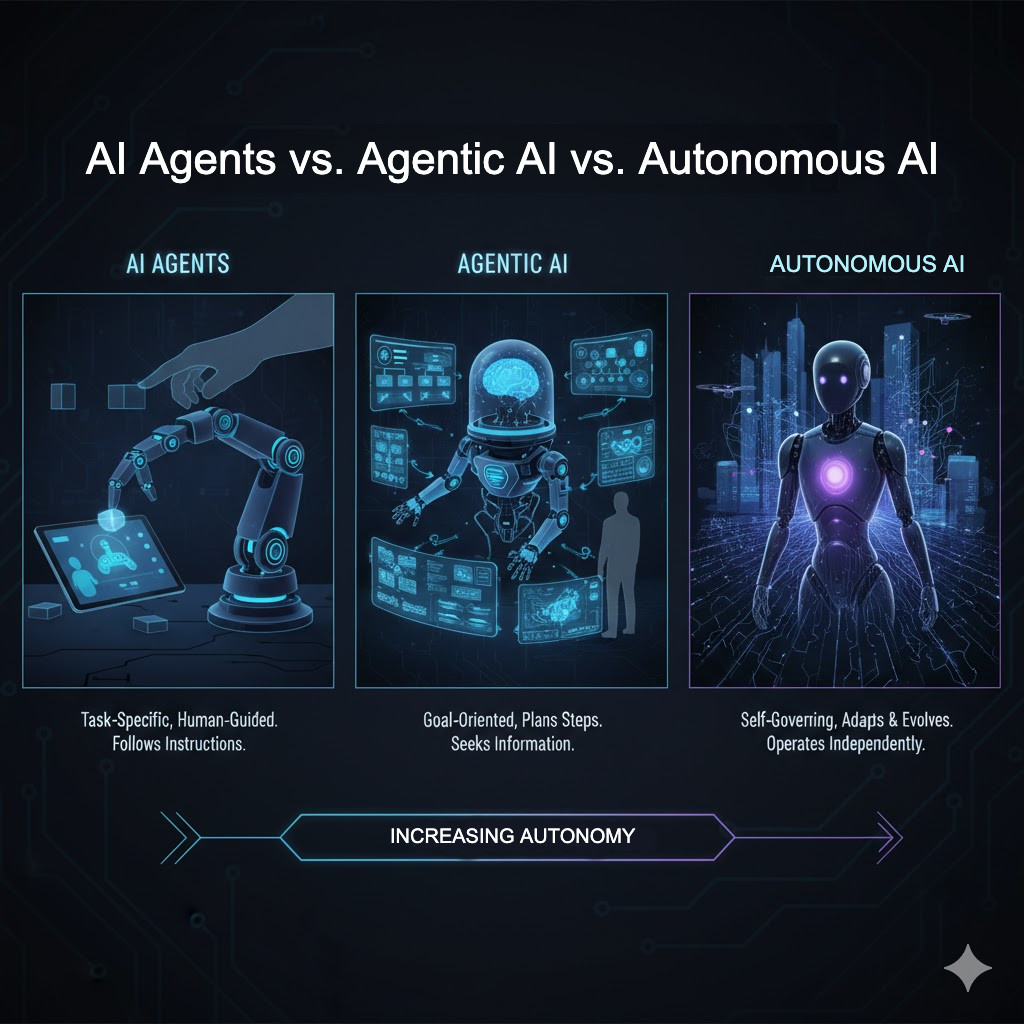
Agentic AI: Navigating the Shift to Autonomous Development Workflows
The interaction model with AI is undergoing a fundamental transformation. For years, our engagement with AI, particularly large language models (LLMs), largely revolved around single-prompt interactions. We’d issue a command, get a response, and then repeat. While powerful, this model represented a reactive approach. Now, in 2026, we're witnessing a decisive pivot towards agentic systems: long-running, goal-driven software that operates with a significant degree of autonomy.
This isn't merely an incremental update; it's a paradigm shift for how we conceive and construct software. Developers are increasingly relying on specialized agentic frameworks to manage the intricate interplay of reasoning, memory, tool utilization, and collaboration among multiple AI agents. This new layer of abstraction is becoming indispensable in modern application architecture.
What Defines an AI Agent?
At its core, an AI agent is a piece of software capable of autonomously reasoning, setting goals, and performing tasks on behalf of a user or another system. Unlike traditional LLM interactions, agents possess a degree of agency, allowing them to learn, adapt, and make decisions independently to improve their behavior and achieve specific objectives over time.
The operational mechanism of an AI agent is typically cyclical, following a “perceive, reason, act, reflect” (PRAR) loop:
Perceive: The agent observes its environment. This includes parsing user input, understanding the current system state, identifying available tools, and retrieving relevant information from its memory to establish context and constraints.
Reason: Utilizing an LLM or a hybrid logic system, the agent plans its next steps, makes decisions, and selects appropriate actions to move closer to its goal.
Act: The agent executes its chosen actions. This might involve calling external APIs, updating internal memory stores, or triggering subsequent workflows.
Reflect: Crucially, the agent evaluates the outcome of its previous actions. This introspection allows it to adjust future decisions, refine its plans, or modify prompts to enhance overall results and efficiency.
The key differentiator here is autonomy. Agents are proactive. They don't require continuous human intervention after an initial goal is set; they work towards that goal based on defined rules and parameters.
The Necessity of Agentic Frameworks
While it’s technically possible to construct a rudimentary AI agent without a dedicated framework, doing so at scale quickly exposes significant challenges. Agentic frameworks provide the essential infrastructure to build, run, and control AI agents in a robust, scalable, and secure manner. They elevate experimental agent builds into maintainable software.
Most modern frameworks offer three core capabilities:
- Orchestration: This defines how agents are sequenced, coordinated, and allowed to collaborate. This can range from simple sequential flows to complex graph-based models where the flow is explicitly defined, offering maximum control over agent behavior.
Tools: These define how agents interact with external systems. Think APIs, databases, or even file systems. Tools enable agents to perform real-world actions beyond generating text.
- Memory: This capability dictates how agents retain and retrieve information across different steps or sessions, allowing them to maintain context and learn from past interactions.
Beyond these core elements, frameworks are vital for enabling multi-agent coordination, where specialized agents communicate and work together on larger tasks. They facilitate Human-in-the-Loop (HITL) checkpoints, allowing developers to review and approve critical decisions before an agent acts. Furthermore, they are instrumental in achieving observability (seeing what an agent is doing), control (guiding its behavior), and reproducibility (getting consistent results from repeated agent runs).
The Great Convergence in Coding Agents
One of the most striking observations in 2026 is the convergence of AI coding agents, despite a seemingly fragmented ecosystem of tools like Claude Code, Codex, Copilot, Gemini, Cursor, Devin, and Windsurf. While interfaces and underlying models may differ, a common architectural pattern is emerging, centering on long-running execution and sub-agent orchestration. The industry has collectively identified the foundational ingredients for making agents truly useful in real-world development.
- These coding agents are evolving into three distinct archetypes, each optimized for different developer workflows:
- CLI-first Agents: These agents reside directly within the terminal, acting as highly capable command-line collaborators. They excel at orchestrating complex development workflows, allowing experienced engineers to integrate AI assistance naturally into their existing terminal-centric environments. This category is currently the most flexible and adaptable.
- IDE-native Agents: Embedded directly within the development environment (like Copilot within VS Code), these tools treat the IDE as their operational platform. They operate directly on the editor state, capable of editing multiple files simultaneously and understanding the broader project structure. Their primary goal is to optimize developer flow, keeping engineers within the editor while the agent handles repetitive or mechanical tasks.
- Cloud Engineering Agents: This archetype represents the most disruptive shift. These agents don't just assist; they take work assignments and execute them independently in persistent cloud environments. They can explore entire repositories, implement features, and even run entire development lifecycle drafts. This is the genesis of delegated software engineering, where developers assign work to agents rather than merely asking for coding help.
These archetypes, despite their varied interfaces, share common architectural primitives. This includes the use of human-readable configuration files to define project structure and conventions, enabling agents to operate intelligently within a codebase. Crucially, agents now interact directly with real development tools—such as Git, build systems, and test runners—moving beyond mere text generation to direct execution. Furthermore, many platforms support specialized agents, allowing for a team-based approach where different AI entities handle specific aspects of a task.
Reshaping Engineering Workflows
The implications for engineering workflows are profound. We are moving beyond the era of AI as a pair programmer or an autocomplete utility. The future of development will look less like writing code character by character and more like managing a sophisticated team of AI engineers. Agentic AI will run the first drafts of the software development lifecycle, from initial implementation to testing and integration, leaving humans to focus on steering, reviewing, and tackling higher-level architectural and design challenges.
This shift from prompt-based interaction to genuine autonomy is not without its complexities. It demands a pragmatic understanding of agent capabilities, robust framework selection, and meticulous design of Human-in-the-Loop checkpoints to ensure reliability, safety, and control. As developers, our role is transitioning from purely coding to architecting, configuring, and overseeing these autonomous systems. The ability to effectively define goals, set parameters, and interpret agent outputs will be as crucial as writing efficient code.
The trajectory is clear: agentic AI is not just a passing trend but a foundational evolution in software engineering. Embracing this shift requires us to re-evaluate our tools, our processes, and ultimately, our definition of what it means to build software.