Agentic AI: The Pragmatic Shift to Autonomous Software Systems
Artificial intelligence continues its rapid evolution, moving through distinct phases. We've seen predictive AI analyzing data to forecast outcomes, and more recently, generative AI (GenAI) creating novel content like text and images. Now, a new paradigm is gaining traction: Agentic AI, where systems exhibit agency, making decisions and taking actions autonomously in complex, real-world scenarios.
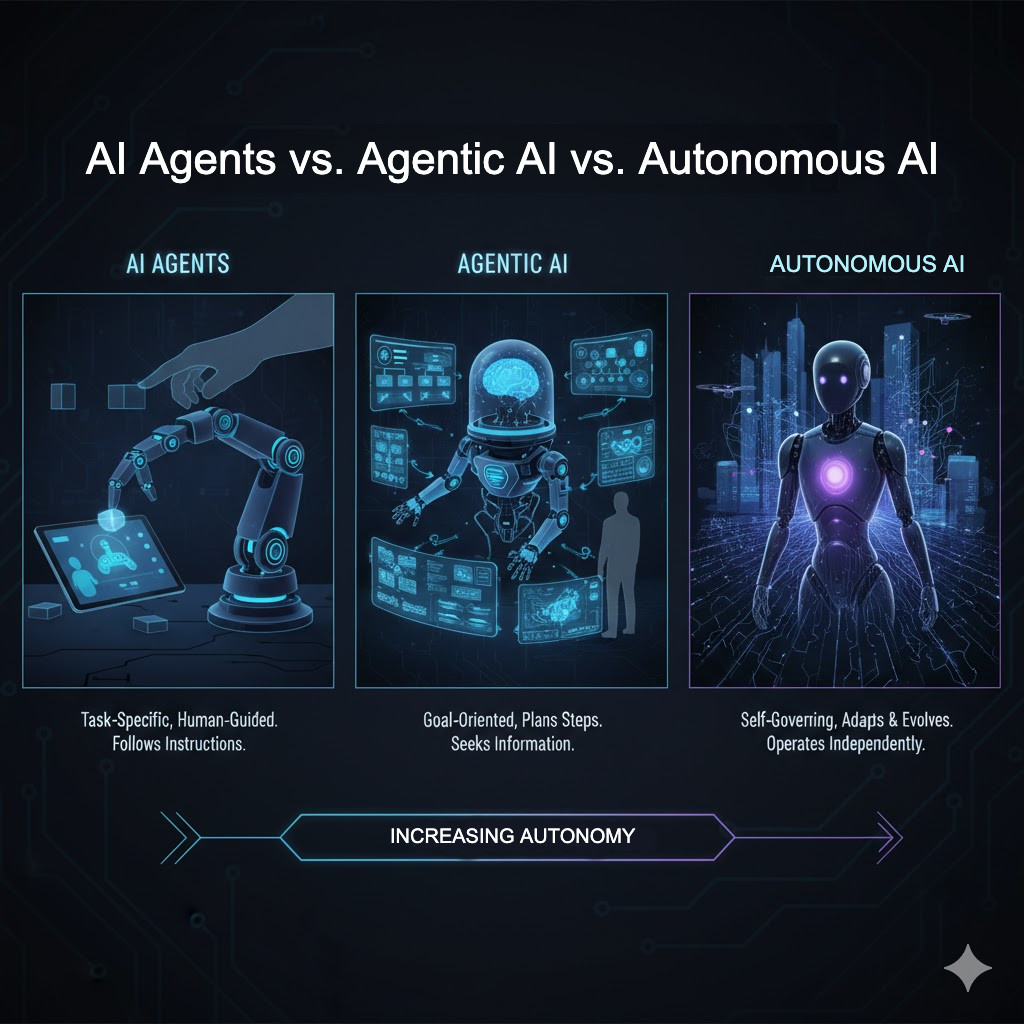
From a developer's perspective, this isn't just another buzzword; it signifies a fundamental shift in how we conceptualize and build software. Unlike a chatbot that responds to a direct prompt, an agentic AI is proactive. It receives a high-level goal and then independently plans, executes, and adapts its actions to achieve that goal, often spanning multiple steps and interacting with various external systems. This is GenAI 2.0 – moving beyond automating rote summarization tasks to automating entire workflows.
Defining Agentic AI: Beyond the Prompt
The core of agentic AI lies in its ability to operate independently. An AI agent, in this context, is an autonomous software system designed to perceive its environment, reason about its state, make decisions, and take actions to achieve predefined goals. This is a significant leap from previous AI models, which primarily functioned reactively or as sophisticated tools requiring constant human input.
Key characteristics of agentic AI systems that developers need to understand include:
Autonomy: The system operates without continuous human supervision, performing tasks and making decisions based on its understanding of the context and data. Once given an objective, it determines the necessary steps and carries them out, rather than waiting for explicit instructions at each stage. This agency is what gives the field its name.
Adaptability: Agentic AI agents are designed to learn from interactions and feedback, continuously improving their performance. They don't follow rigid, hard-coded rules but leverage probabilistic models and continuous learning to adjust to changing environments and unforeseen circumstances.
Goal-Directed Behavior: Instead of simply generating an output when prompted, these agents are oriented towards achieving specific, often complex, goals. This involves breaking down a high-level objective into actionable sub-goals and executing multi-step plans. Consider an agent tasked with planning a business trip: it might autonomously research flights, book hotels, manage calendar entries, and even process payments, all while adapting to real-time changes like flight delays.
Tool Use and Integration: For agents to achieve complex goals, they often need to interact with external tools and services. This means leveraging APIs to communicate with other software, access databases, send emails, or even perform financial transactions. This capability makes them powerful components within larger, distributed workflows.
Practical Implications for Developers
For engineers, agentic AI introduces new paradigms for system design. We're moving from building systems that respond to explicit commands to architecting environments where software agents autonomously pursue objectives. This shift opens up immense possibilities across industries:
Automated Workflows: Imagine agents handling cross-departmental tasks, from supply chain optimization to customer service resolution, coordinating with various legacy and modern systems. For example, an agent could manage incident response, identifying issues, notifying teams, and initiating corrective actions.
Intelligent Assistants: Beyond simple chatbots, these agents could act as highly capable personal or enterprise assistants, capable of complex scheduling, research, and resource allocation.
Self-Managing Infrastructure: Agents could monitor and optimize cloud resources, automatically scale services based on demand, or even proactively identify and mitigate security threats.
However, this capability also brings significant architectural considerations. Designing systems that facilitate robust agent interaction, handle potential conflicts, and provide necessary guardrails will be paramount.
The Infrastructure Beneath Autonomous Action
Effective agentic AI relies heavily on a robust, real-time data infrastructure. Agents need current, accurate information to make informed decisions and adapt effectively. This necessitates:
Real-time Data Processing: Agents cannot operate on stale data. They require immediate access to the latest environmental state, whether it's customer behavior, market conditions, or system metrics. This points to the need for low-latency data pipelines and event-driven architectures.
Distributed Systems: Agents will likely be distributed across various services and platforms, each specializing in different aspects of a task. Designing for communication, coordination, and state management across these distributed components becomes a critical challenge. Fault tolerance, consistency, and scalability are non-negotiable requirements.
Observability and Monitoring: With autonomous systems making decisions, comprehensive logging, monitoring, and observability tools are more crucial than ever. Developers need to understand why an agent took a particular action, debug its reasoning process, and ensure it operates within defined parameters.
Challenges and Strategic Considerations
While the potential of agentic AI is vast, deploying these systems comes with significant challenges that require careful strategic planning, not just technical prowess:
Data Quality and Governance: The autonomy of agents amplifies the impact of poor data quality. Inaccurate or biased data can lead to suboptimal, or even harmful, autonomous actions. Robust data governance frameworks, validation pipelines, and data lineage tracking are essential.
Trust and Security: Granting AI systems agency introduces new security vectors. Ensuring agents operate securely, protect sensitive information, and cannot be exploited or manipulated is a complex task. Authentication, authorization, and secure communication protocols become even more critical.
Explainability and Control: Understanding an agent's decision-making process is vital for debugging, auditing, and building trust. Developers need mechanisms to inspect an agent's internal state, reasoning, and action history. Furthermore, establishing clear human-in-the-loop protocols and kill switches is necessary for high-stakes applications.
Strategy and Risk Management: The economic implications are touted as multi-trillion dollar opportunities, yet many organizations are still grappling with how to strategically deploy agents without fully understanding their capabilities or risks. A comprehensive strategy, including systematic risk assessment and mitigation frameworks, is an absolute imperative before widespread deployment.
The Road Ahead
Agentic AI is not a distant future; it's already here, albeit in its nascent stages. We're seeing major software vendors integrate agentic capabilities, pushing these systems into enterprise environments. For developers, this means a shift in focus from merely implementing features to designing intelligent, self-orchestrating systems.
Our role will evolve towards defining high-level goals for agents, architecting the environments they operate in, building robust integration points, and—critically—implementing the guardrails, monitoring, and governance necessary to ensure these autonomous systems operate effectively, ethically, and securely. The next decade will see us building a new class of software, where our code doesn't just execute instructions, but enables intelligent agents to pursue objectives with increasing independence. It's a challenging but ultimately transformative era for software engineering.