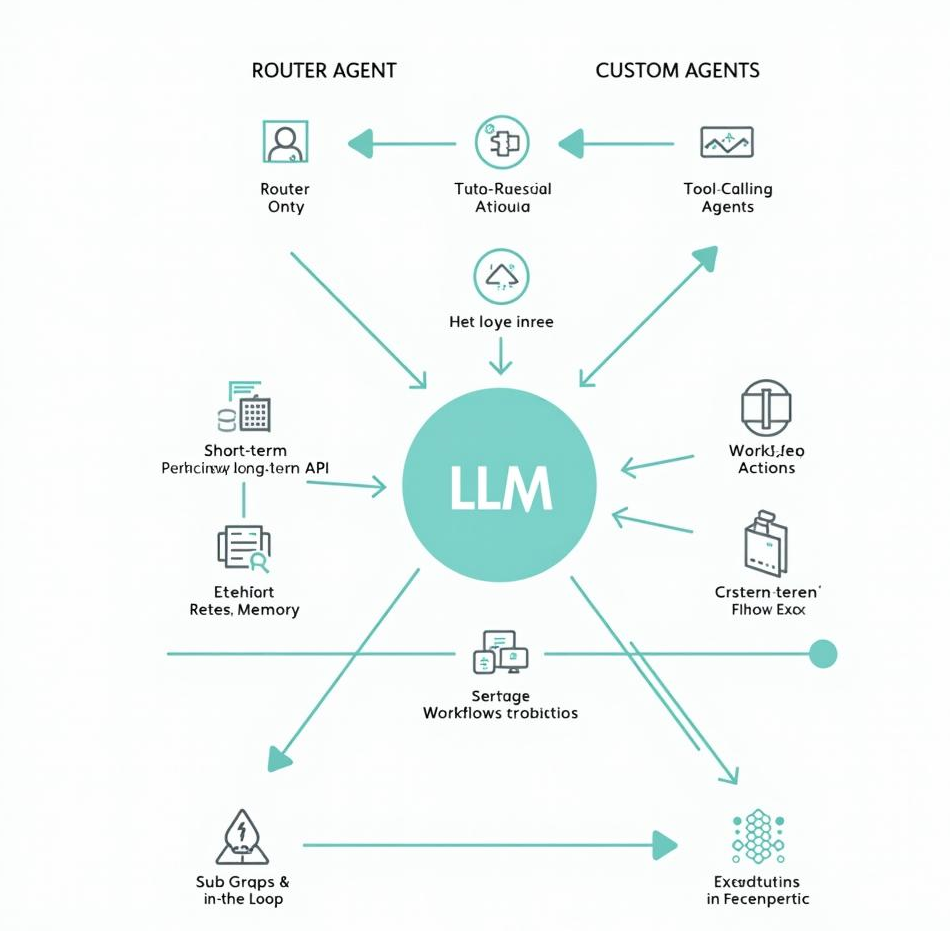
Agentic LLMs: From Prompt Engineering to Autonomous Systems in 2026
The world of AI in 2026 is a different beast than even a year or two ago. We're well past the honeymoon phase of prompt engineering as a primary interaction model. The focus has decisively moved towards agentic systems—long-running, goal-driven software that leverages large language models (LLMs) to make autonomous decisions and execute complex tasks. This isn't just an evolutionary step; it's a fundamental architectural shift.
For us, the developers, this means a new layer of complexity and power. Building autonomous systems now heavily relies on agentic frameworks, which are quickly becoming a non-negotiable part of our modern application stack. Frameworks like LangChain and AutoGen have paved the way, but a vibrant ecosystem of specialized and open-source alternatives is constantly emerging, all promising different agentic capabilities.
What Defines an AI Agent?
Before diving into the frameworks, let's nail down what an AI agent actually is. Fundamentally, an AI agent is a piece of software capable of autonomously reasoning, setting goals, and performing tasks on behalf of a user or another system. The key here is agency—the ability to learn, adapt, and make decisions independently, improving its behavior over time to achieve specific outcomes.
Agents don't just generate text; they operate within a continuous cycle often referred to as Perceive, Reason, Act, Reflect (PRAR):
Perceive: The agent observes its environment—user input, system state, available tools, and its own memory—to grasp the current context and task constraints.
Reason: Using an LLM or a hybrid logic system, it plans, makes decisions, and selects appropriate actions.
Act: It executes these actions, which could involve calling external tools (APIs, databases), updating its internal memory, or triggering further workflows.
Reflect: Crucially, it evaluates the outcomes of its actions, learning from successes and failures to adjust future plans and improve overall performance. This feedback loop is what differentiates an agent from a simple chatbot or a one-shot LLM call.
Unlike traditional LLMs, agents are proactive. They don't require continuous user input to perform tasks; they work autonomously based on a specified set of rules and parameters, often until a defined goal is met or a budget is exhausted.
The Necessity of Agentic Frameworks
- While it's technically possible to stitch together an agent from scratch, agentic frameworks provide the essential infrastructure to build, run, and control AI agents at scale. They elevate experimental builds into maintainable, production-grade software by providing three core capabilities:
- Orchestration: This controls how agents are sequenced, coordinated, and allowed to collaborate. This can range from simple sequential chains to complex multi-agent systems where different agents specialize and communicate.
- Tools: These define how agents interact with the external world. Think APIs, databases, web search, code interpreters, or custom internal systems. The ability to use tools is what turns a text generator into an action engine.
- Memory: This dictates how agents retain and retrieve information across steps or even long-running sessions, providing context and continuity.
Beyond these core elements, frameworks facilitate critical features for robust agent deployments:
Multi-agent Coordination: Enabling multiple agents to communicate, plan together, and specialize in different aspects of a task.
Human-in-the-Loop (HITL) Checkpoints: Intentional pause points where a human can review, approve, or correct an agent's proposed action, ensuring safety and compliance.
Observability, Control, and Reproducibility: The ability to trace agent behavior (often via OpenTelemetry-compatible tracing), guide its decisions, and ensure consistent results across runs.
We've seen significant advancements here in 2026. Microsoft's Agent Framework, building on concepts from Semantic Kernel and AutoGen, is a notable unified runtime. OpenTelemetry compatibility for tracing is now standard, and dedicated memory layers like Mem0, Letta, and Zep have matured into standalone products.
Core Components of an LLM Agent Architecture
- To build or even just understand these systems, we need to look at the foundational components:
- Language Model Core: This is the reasoning engine. Our choices vary: Frontier Hosted Models: GPT-5, Claude Opus 4.7, Gemini 3.x. Offer top-tier reasoning but come with higher costs per call. Open-Source Frontier-Class: Llama 4.x, DeepSeek-V3.x, Qwen3. These are served on platforms like vLLM, TGI, or SGLang, offering competitive reasoning at potentially lower operational costs. Smaller, Dedicated Agent Models: Mid-size open models fine-tuned specifically for tool use and reliable JSON output, often serving as cheaper 'executors' while a frontier model acts as the 'planner'.
- Key attributes for agent quality are context window size (many models now offer hundreds of thousands to over a million tokens), tool-use ability (function-calling accuracy, JSON output reliability), reasoning chain length, and naturally, cost per output token.
- Memory Layers: Agents need more than just an in-context conversation window. Production use cases typically rely on three layers: Working Memory: The current conversation in the LLM's context window, cleared per turn. Episodic Memory: Persistent records of past task runs, often stored in a vector database or structured table, retrieved by similarity or rule. Procedural Memory: Learned tool-use heuristics, frequently baked into system prompts or through small fine-tunes.
- Dedicated memory layers like Mem0, Letta, and Zep abstract these patterns into unified APIs, often integrating with tracing for grounded evaluation of retrieved memories.
- Tool and Plugin Layer: This is where agents gain their agency over the external environment. The 2026 toolbox is sophisticated: Typed Function Calls: Pydantic models or JSON schema allow agents to fill in arguments, with runtimes validating calls before execution, substantially reducing malformed interactions. MCP (Model Context Protocol) Servers: Anthropic's open standard for portable tool catalogs has gained wide adoption. Web Search and Retrieval: Services like Tavily, Brave, Exa, plus enterprise indexes. Code Execution Sandboxes: Platforms like E2B, Modal, Daytona, or self-hosted interpreters for safe code execution. Database and API Connectors: Vendor-specific SDKs wrapped as typed tools.
Emerging Architectures and Orchestration Paradigms
The way agents make decisions and control processes defines their 'agentic' level. We're seeing three main levels:
- Level 1: AI Workflows (Output Decisions): Here, agentic behavior happens at the model level, making decisions based on natural language instructions to generate output. We prompt better, but the model still decides what to generate.
Level 2: Router Workflows (Task Decisions): This is where most current innovation lies. Models decide on tools and control the execution path within a regulated, predefined environment. These 'routers' can skip tasks or use available tools but cannot modify the process itself.
- Level 3: Autonomous Agents (Process Decisions): The holy grail—agents that can create new tasks and tools on their own, modifying their process based on reflection. This is still a more aspirational stage, though active research and early implementations are pushing boundaries.
Regarding orchestration, graph-based orchestration is gaining traction for its explicit control, organizing agents and tools as nodes in a directed graph, ensuring predictable flows rather than allowing agents to freely decide every next step. This provides the 'guardrails' necessary for reliable operation.
The Road Ahead
Building agentic workflows is complex, and the field is evolving at an incredible pace. The focus for 2026 is squarely on creating robust guardrails and feedback loops that allow agents to operate autonomously without 'going rogue.' Architectural risks are being addressed not just by improving reasoning, but by rethinking the entire system design. From simple LLM calls, we've moved to agents, and now to multi-agent systems within shared orchestration planes.
For developers, the challenge and opportunity lie in understanding these new architectures, leveraging the right frameworks, and carefully designing agents to be reliable, observable, and safe. The days of treating an LLM as a black box are over; we're now designing sophisticated, interconnected systems with true agency.