Architecting for Intelligence: Understanding AI-Native Development Platforms
The concept of "AI-native development" is gaining traction, and it's more than just slapping a machine learning model onto an existing codebase. As developers, we're constantly evaluating new paradigms, and this one demands a closer look. An AI-native approach means designing and building software with AI models as foundational components, rather than afterthoughts or bolted-on features. It signifies a profound shift from merely integrating AI to architecting systems that are inherently intelligent from the ground up.
Beyond "AI-Integrated": A Foundational Shift
Many of us have worked on projects that incorporate AI. We might have added a recommendation engine to an e-commerce platform or integrated a sentiment analysis API into a customer service tool. This is AI-integrated software: existing systems augmented with AI capabilities. While valuable, it often treats AI as an add-on, leading to impedance mismatches, convoluted data flows, and performance bottlenecks. An AI-native system, in contrast, bakes intelligence into every part of how the software works. Its core logic and user experience are fundamentally shaped by the AI models it deploys.
Consider an application designed to provide instant, actionable insights. An AI-native design for this would leverage low-latency inference, predictive analytics, and prescriptive modeling from the very first architectural sketches. The data pipelines, service boundaries, and even the API contracts would be optimized for feeding and consuming AI-driven outputs, allowing the software to "think" and adapt to new scenarios rather than just execute predefined rules.
The Core Tenets of AI-Native Design
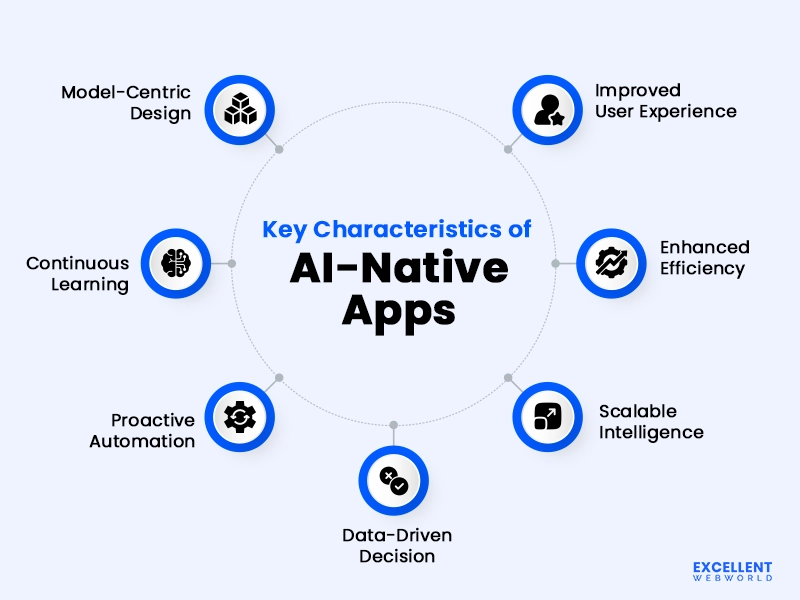
- What does it mean to build software in an AI-native way? It implies several key characteristics:
- Intelligence as a First-Class Citizen: AI models aren't external dependencies; they are core components of the system's business logic. This influences everything from data schema design to error handling.
- Proactive and Adaptive Behavior: AI-native applications aren't just reactive; they use predictive and prescriptive capabilities to anticipate needs and guide users or automate actions based on learned patterns.
- Optimized for Iteration and Evolution: Given that AI models are constantly refined and retrained, the software architecture must facilitate rapid deployment of new model versions, A/B testing, and robust rollback strategies.
- Codebase Clarity for AI: Codebases that are amenable to AI-native development tend to exhibit consistent naming conventions, strong typing, well-scoped modules, comprehensive documentation, and clean architectural patterns. This isn't just good practice; it's crucial for tools and platforms that might, for instance, infer code intent or assist in generation based on existing patterns.
Why the Shift? Tangible Benefits for Developers
The move towards AI-native platforms isn't just theoretical; it's driven by practical advantages. Teams adopting mature AI-native systems report significant gains. We're talking about 10-30% improvements in code velocity and a substantial 30-60% reduction in testing overhead. These aren't minor tweaks; they represent fundamental shifts in efficiency. Faster delivery cycles and reduced testing translate directly into quicker innovation and more reliable scaling across complex environments.
By automating routine coding tasks, generating adaptive tests, and streamlining release processes, AI-native platforms free up developers to focus on higher-level architectural challenges and unique problem-solving, rather than repetitive boilerplate.
Deconstructing AI-Native Development Platforms
So, what are these platforms? They're not just a collection of AI libraries or a cloud-based Jupyter Notebook environment. An AI-native development platform provides an integrated ecosystem designed to manage the entire lifecycle of AI-centric applications. This includes:
Data Management: Tools for data ingestion, cleaning, feature engineering, and versioning, often optimized for large-scale AI datasets.
Model Lifecycle Management (MLOps): Integrated capabilities for training, tracking, deploying, and managing machine learning models, including versioning and reproducibility.
Inference Services: Optimized infrastructure for serving models with low latency and high throughput.
Monitoring and Observability: Specialized tools to track model performance, detect data drift, concept drift, and ensure AI fairness.
Automation: Orchestration tools that automate continuous integration, continuous delivery (CI/CD), and continuous training (CT) pipelines tailored for AI artifacts.
Developer Tooling: IDE integrations, code generation, and debugging tools specifically designed to assist in building AI-first applications.
These platforms aim to abstract away much of the underlying infrastructure complexity, allowing developers to focus on model development and application logic.
AI-Native Platforms vs. Traditional Software Development & DevOps
While traditional DevOps focuses on automating the build, test, and deployment of code artifacts, AI-native platforms extend this significantly. They introduce a new layer of concerns that traditional CI/CD pipelines often struggle with:
Data as a First-Class Citizen: Unlike traditional software, AI applications are highly dependent on data quality and provenance. AI-native platforms incorporate robust data versioning and pipeline management.
Model as a Living Artifact: Models are not static code. They degrade, require retraining, and can be influenced by new data. AI-native platforms provide continuous monitoring and retraining loops to ensure models remain performant.
Complexity of Experimentation: AI development involves extensive experimentation with different models, hyperparameters, and datasets. Platforms provide tools for tracking these experiments and promoting successful ones to production.
Observability Challenges: Monitoring an AI application involves not just infrastructure metrics but also model-specific metrics like accuracy, recall, and detection of data/concept drift.
In essence, AI-native platforms embed MLOps deeply into the developer workflow, making it a seamless part of software engineering rather than a separate discipline.
The Pragmatic View: Challenges and Considerations
While the potential is significant, AI-native isn't a silver bullet. It introduces its own set of complexities that developers and organizations must address:
- Architectural Redesign: Transitioning to an AI-native approach often requires rethinking existing architectures, which can be a substantial undertaking.
Talent Upskilling: Development teams need to deepen their understanding of machine learning principles, data science, and MLOps practices.
Data Quality and Governance: The criticality of high-quality, well-governed data becomes even more pronounced. Poor data will lead to poor AI, regardless of the platform.
Vendor Lock-in: As specialized platforms emerge, there's a risk of becoming overly dependent on a specific vendor's ecosystem.
- Cost-Benefit Analysis: While efficiency gains are promised, the initial investment in new platforms, tools, and training needs careful consideration.
Organizations must pragmatically assess if their current problems and future goals truly warrant this fundamental shift. It's not for every project, especially those where AI remains a peripheral concern.
Looking Ahead: The Evolving Landscape
By 2026, these platforms are expected to deliver clear value, driving faster delivery cycles and innovation. The industry is moving towards more integrated solutions that streamline the entire AI development lifecycle. We're seeing a push for platforms that offer comprehensive toolsets, from data preparation to model deployment and monitoring, catering to an increasing array of AI patterns and use cases. The goal is to make sophisticated AI development accessible and efficient for a broader range of engineering teams.
Conclusion: A Fundamental Rethink
AI-native development platforms represent a fundamental rethink of how we engineer software. It's about designing systems where intelligence isn't an afterthought but an intrinsic property, influencing every architectural decision from the outset. For developers, this means shifting our mindset to embrace AI models not just as functional components but as core drivers of application behavior and evolution. The promise is significant: building more intelligent, adaptive, and efficient software that can continuously learn and improve. The challenge, as always, lies in carefully navigating the new complexities and ensuring we apply these powerful tools judiciously to solve real-world problems.