Autonomous Agents and the Shift to Agentic AI: A Developer's Lens
The past few years have undeniably been marked by the rapid ascent of large language models and generative AI. We've become accustomed to systems that summarize documents, generate code snippets, or draft emails—tools that largely respond to direct human prompts and automate rote work. It's been a powerful wave, but what's emerging now is a fundamental shift: agentic AI.
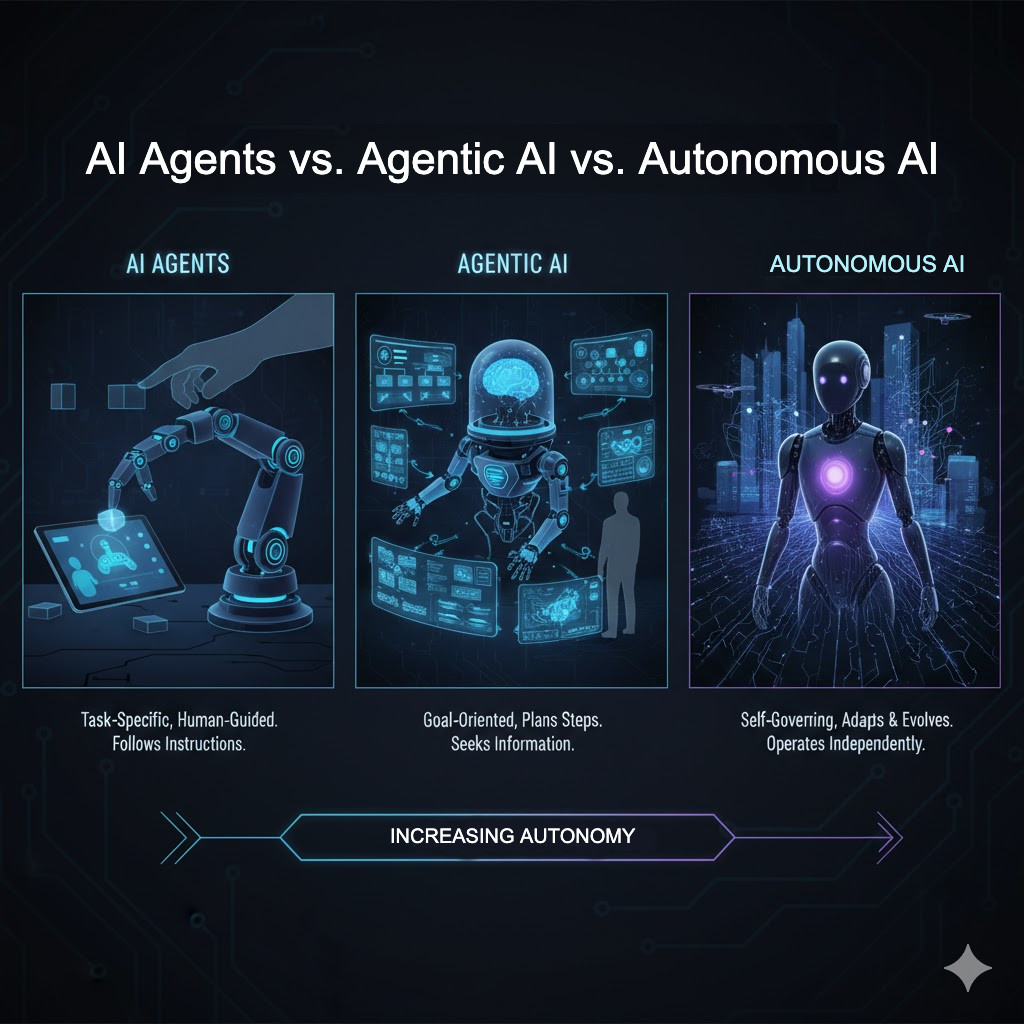
Agentic AI represents the next major evolution. These are not just advanced chatbots; they are AI systems, often referred to as AI agents, that operate with a degree of autonomy. They perceive their environment, reason about objectives, and take actions to achieve predefined goals, all without needing constant, step-by-step human intervention. In essence, they possess 'agency'—the ability to decide and act independently.
This is a significant departure from even the most sophisticated generative AI systems. While a generative model might produce text when asked, an agentic system proactively makes decisions and acts in pursuit of a broader objective. Think of the current generative AI era (often termed GenAI 1.0) as automating tasks based on explicit instruction. Agentic AI, in contrast, ushers in a GenAI 2.0 era, where systems manage multi-step processes and adapt to dynamic conditions to achieve higher-level outcomes.
Core Characteristics of Agentic AI
For developers evaluating this technology, understanding the defining traits of agentic AI is crucial. These systems are not merely following a script; they embody several key characteristics:
Autonomy in Action
At its heart, agentic AI is about independence. Once given a high-level objective, an autonomous agent determines its own course of action and carries it out. This means it decides which actions to take and when to take them to meet its goals, rather than waiting for a human to dictate each step. This independence is what fundamentally distinguishes it from earlier AI assistants that required explicit commands for every move.
Adaptability and Contextual Awareness
Agentic systems are not rigid. They learn from interactions and feedback, continuously improving their performance and adjusting to new situations. Instead of relying on a fixed set of rules, they leverage probabilistic models and ongoing learning to navigate changing environments. This adaptability allows them to handle scenarios they weren't explicitly coded for, using context awareness and domain knowledge to respond intelligently. For instance, a generic customer service platform provides canned responses, but an agentic system in healthcare understands medical terminology and adheres to regulations, adapting its support to evolving patient concerns.
Goal-Directed and Proactive Behavior
Unlike reactive systems that only respond when triggered, agentic AI is inherently proactive. It anticipates needs, identifies emerging patterns, and takes the initiative to address potential issues before they escalate. Its behavior is driven by an awareness of its environment and its ability to evaluate potential outcomes against long-term goals. Imagine a supply chain agent monitoring inventory, tracking weather, and rerouting shipments to avoid delays—that's proactivity in action.
Collaborative Intelligence
Agentic AI isn't designed to operate in isolation. These systems are built to collaborate—both with humans and with other AI agents. They can understand shared objectives, interpret human intent, and coordinate actions within a broader team. This is particularly powerful in complex workflows where human oversight or decision-making is still necessary, as agents can synthesize inputs from multiple sources and present actionable insights.
Hyper-Specialization and Multi-Agent Systems
Many advanced agentic AI solutions are built upon an architecture of multiple, hyperspecialized agents. Each agent focuses on a narrow area of expertise, coordinating with others, sharing insights, and handing off tasks as needed. This modular approach allows for significantly deeper domain-specific performance. In a financial services context, one agent might specialize in regulatory compliance, another in fraud detection, and a third in portfolio optimization. Together, they can monitor transactions, flag anomalies, and recommend adjustments while maintaining compliance—a feat far beyond a single, monolithic AI.
Developer Utility and Real-World Applications
While the hype around AI agents can sometimes overshadow practical utility, the applications are compelling for developers looking to build truly transformative systems. We're moving beyond simple automation to genuine autonomy.
Early examples like self-driving vehicles or intelligent virtual assistants hinted at this, but the scope is rapidly expanding. We're seeing agents automate complex tasks that span departments and functions—from optimizing employee shift schedules (and dynamically adjusting for sick leave) to comprehensive treatment planning in healthcare, where an agent coordinates with various medical teams.
For developers, this means building systems that can:
- Execute Multi-step Plans: Go beyond single prompts to achieve complex objectives through a series of actions.
Utilize External Tools: Integrate seamlessly with existing software, APIs, and digital environments to gather information and perform actions.
- Perform Economic Transactions: With appropriate permissions, agents can interact with payment systems to book services or make purchases.
These capabilities represent a shift from merely assisting humans to actively accomplishing tasks on their behalf, often integrating with legacy systems and cloud services through standard APIs.
Challenges and Strategic Considerations
Despite the clear potential, developers must approach agentic AI with a pragmatic mindset. The challenges are real and demand thoughtful architectural and strategic planning.
First and foremost, the perennial issues of data quality, governance, trust, and security remain paramount. Autonomous agents operating independently amplify these concerns; a biased or insecure agent could propagate errors or vulnerabilities at scale. Implementing robust data pipelines and strict security protocols is non-negotiable.
Complexity management is another significant hurdle. Designing, deploying, and monitoring multi-agent systems requires sophisticated orchestration. Ensuring agents effectively communicate, coordinate, and hand off tasks without conflicts or redundant efforts is a non-trivial engineering challenge. Debugging an emergent behavior in a system of interacting autonomous agents is far more complex than debugging a linear application.
Furthermore, many organizations are adopting agentic AI without fully understanding its capabilities or having a formal strategy and risk management framework in place. For developers, this translates to an imperative to advocate for and help establish these frameworks. Simply wrapping an LLM with some tool-use capabilities isn't a robust agentic strategy. We need to systematically assess both the risks and the business benefits to deliver true value.
Finally, the importance of real-time data and distributed systems cannot be overstated. For agents to perceive their environment and act adaptively, they require immediate access to current information. This necessitates robust, low-latency data infrastructure capable of handling high-throughput interactions—a familiar challenge for senior engineers, but one that takes on new criticality with autonomous systems.
The Path Forward
Agentic AI marks a pivotal moment in the evolution of artificial intelligence. It promises systems that can move beyond merely generating content to actively planning, executing, and adapting in pursuit of complex goals. For software engineers, this isn't just a new buzzword; it's a fundamental shift in how we conceive and build AI-powered applications.
Approaching this space requires a blend of cautious skepticism and informed enthusiasm. The opportunities are vast, but so are the engineering complexities and ethical considerations. Our role as developers will be to move beyond the hype, engage with the underlying architectural principles, and build these intelligent agents responsibly and effectively, ensuring they deliver tangible value while navigating the inherent challenges of true autonomy.