Beyond the Copilot: Navigating the Rise of Agentic AI in Software Development
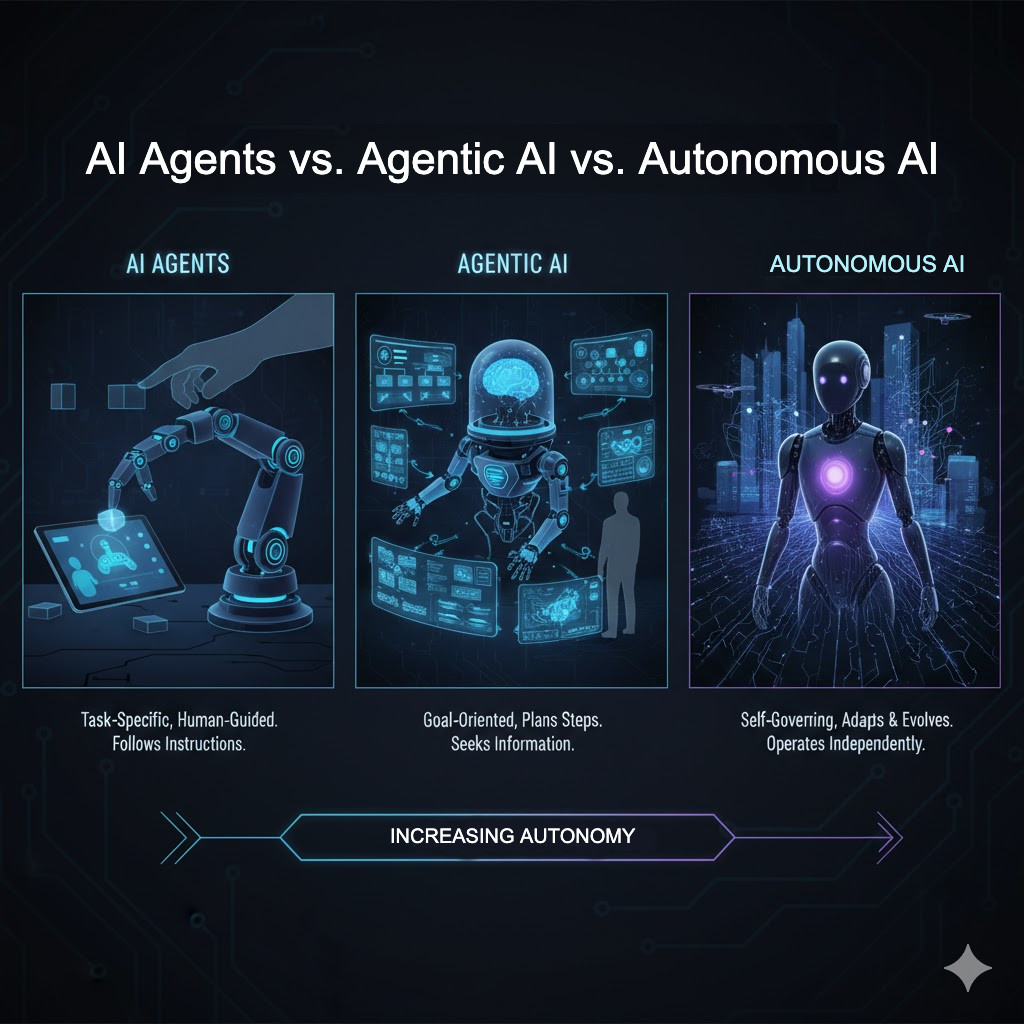
For a while now, we’ve all been tinkering with AI copilots. Whether it's autocompletion suggesting the next line or entire function stubs appearing as if by magic, these tools have become embedded in our daily coding rituals. They’ve undoubtedly boosted individual output, making us faster at boilerplate, refactoring, and exploring new APIs. But what’s coming next is a much more profound shift, one that moves beyond mere assistance to genuine autonomy: Agentic AI and autonomous agents.
As engineers, we tend to be pragmatic, and rightly so. We want to know what actually works, what solves a real problem, and what’s not just marketing fluff. So, let’s cut through the noise and talk about what agentic AI means for the trenches of software development.
What Exactly Are Agentic AI and Autonomous Agents?
At its core, an AI agent is a system or program capable of autonomously performing tasks. It doesn't just respond to a single prompt; it designs its own workflow, utilizes available tools, and executes actions on behalf of a user or another system. Think of it as moving from a highly capable assistant to a team member who can take a high-level goal and figure out the steps to achieve it, often interacting with external environments, making decisions, and solving problems along the way.
This isn't just about natural language processing anymore. These agents are built on an 'agentic architecture' – a design that allows them to perceive their environment, process information, make decisions, collaborate with other agents (forming 'multiagent systems'), take meaningful actions, and crucially, learn from their experiences. They’re structured to automate entire workflows, not just individual code snippets.
The Shifting Sands of the Software Development Lifecycle
The impact of agentic AI on the Software Development Lifecycle (SDLC) is where things get truly interesting. We’re witnessing a restructuring, moving from a code-centric approach to one driven by context and high-level goals. For years, the 'joy of the long way round' meant deep dives into documentation, Stack Overflow rabbit holes, and the satisfaction of wrestling a complex problem into submission. Copilots streamlined parts of this, but we were still firmly in the driver's seat.
With agentic systems, the paradigm shifts. Consider the 'productivity paradox' some studies highlighted: early on, developers using AI tools sometimes took longer due to the overhead of directing, reviewing, and correcting AI output. This was often because the tools weren't truly autonomous; they required constant human oversight for every micro-decision. However, what followed was a striking observation: developers, having tasted the potential, became increasingly unwilling to tackle certain tasks without AI. This suggests that the initial slowness wasn't about AI's inherent inefficiency, but about integrating early-stage AI into traditional, human-driven workflows.
The lesson here is crucial: productivity gains from AI are not universal. They are highly task-dependent and context-dependent. They only truly materialize when teams adapt their workflow structures around these new tools, moving beyond surface-level usage like simple autocomplete. The deeper capabilities of autonomous agents remain largely untapped for many organizations.
Practical Implications for Engineers
- So, what does this mean for us, the people building the software?
- From Coder to Orchestrator: Our role is evolving. Less time will be spent on direct line-by-line coding, and more on defining clear goals, designing high-level agent workflows, evaluating agent outputs, and integrating the results into larger systems. We become the architects and managers of agentic systems.
- New Skill Sets: The emphasis shifts. Prompt engineering becomes less about single-turn queries and more about defining complex, multi-step tasks and constraints for agents. Architectural design will increasingly involve understanding how to break down problems into agent-solvable components, how agents communicate, and how to build robust, fault-tolerant multi-agent systems. Understanding agent capabilities and limitations will be paramount.
- Agentic RAG for Smarter Retrieval: Consider how agents can enhance Retrieval Augmented Generation (RAG). Instead of an LLM simply retrieving data, an agentic RAG system allows the AI to actively conduct information retrieval from multiple sources, handle complex workflows to synthesize that information, and even perform follow-up actions based on its findings. This means more sophisticated data handling for our applications.
- Frameworks and Governance: Building these systems won’t be from scratch. Agentic frameworks are emerging as the building blocks, offering features to streamline development, deployment, and management. Concurrently, 'AI agent governance' will become non-negotiable. As agents gain autonomy, establishing clear processes, standards, and guardrails for safety and ethics isn't just a compliance issue; it’s a fundamental engineering requirement for reliable and responsible systems.
The Future is Context, Not Just Code
The most helpful analogy for this shift is thinking about driving a manual car versus riding in a self-driving electric vehicle. In both scenarios, the goal is to reach a destination. With a manual car, you are intimately involved in every aspect of the how – shifting gears, steering, accelerating, braking. With a self-driving vehicle, you specify the what – the destination – and the vehicle figures out the how. You supervise, intervene if necessary, but the detailed execution is automated.
Our journey as software engineers is moving in that direction. We will increasingly focus on defining the what and the why, crafting the context and constraints within which our agentic systems operate, rather than meticulously dictating every line of code for the how.
This isn't about AI replacing developers; it's about AI changing the nature of development. Organizations that adapt their SDLC now, embracing agentic coding and investing in the frameworks and governance to support it, stand to gain a significant advantage. The influx of investment into this space signals a structural change that engineers cannot afford to ignore.
The era of purely manual coding, or even just copilot-assisted coding, is giving way to a more autonomous, agent-driven paradigm. It demands new skills, new mindsets, and a willingness to rethink our fundamental approach to building software. The challenges are real, but the potential for tackling problems at a higher level of abstraction is immense.