Beyond the Prompt: Architecting Production-Grade Agentic AI Systems
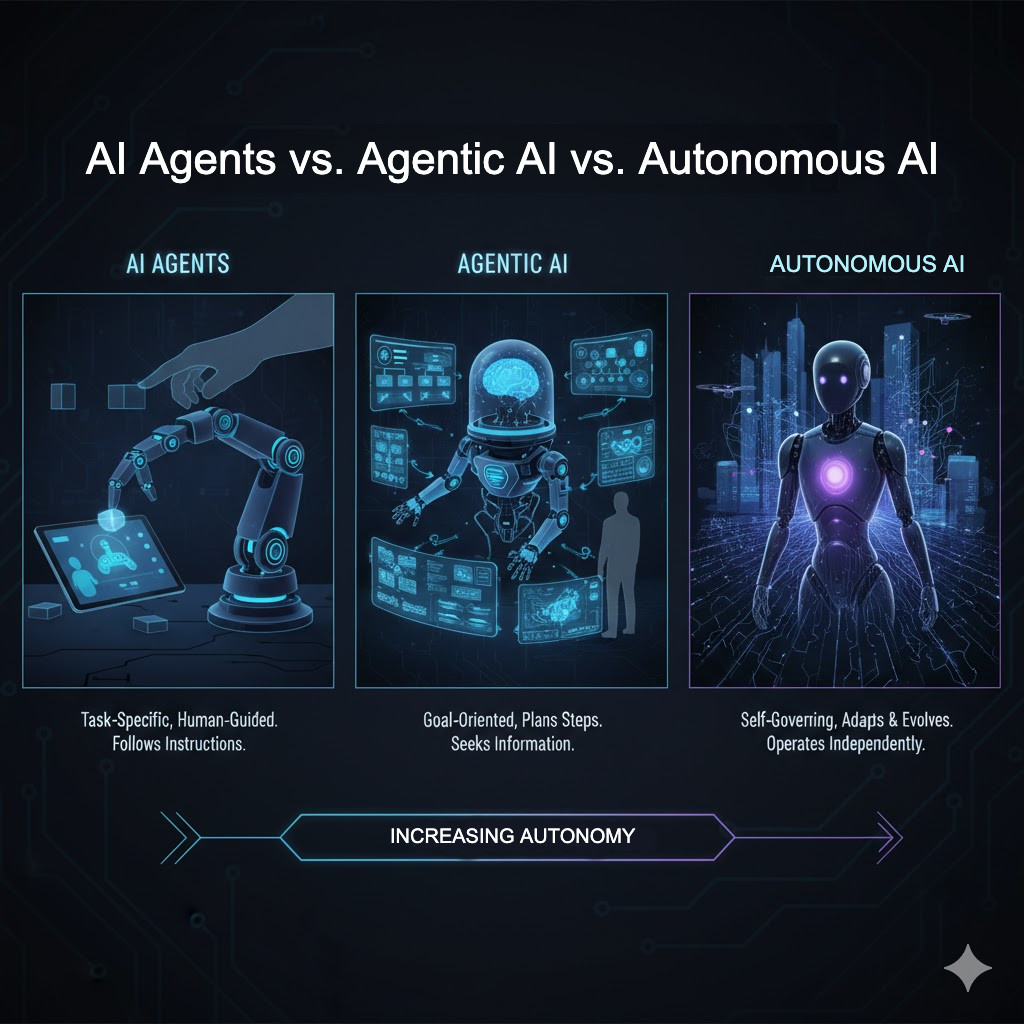
The world of software development is undergoing a fundamental shift. For years, our interactions with AI models largely revolved around discrete, single-prompt requests, often feeling like advanced API calls. However, a new paradigm is taking hold: Agentic AI and Autonomous Agents. These aren't just smarter chatbots; they are goal-driven, long-running software entities capable of perceiving their environment, reasoning, acting, and reflecting on their actions, all with a degree of agency that traditional models lack.
An AI agent is a piece of software designed for autonomous operation. It doesn't require constant human input to perform its tasks. Instead, it operates on a Perceive, Reason, Act, Reflect (PRAR) cycle:
Perceive: The agent observes its environment—user input, system state, available tools, memory—to grasp the current context and task constraints.
Reason: Using a large language model (LLM) or hybrid logic, it plans, makes decisions, and selects appropriate actions.
Act: It executes those actions, which might involve calling external tools (APIs, databases), updating its internal memory, or triggering other workflows.
Reflect: Crucially, it evaluates the outcome of its actions, learning and adjusting its future decisions or plans to refine results and improve performance over time.
This proactive, goal-seeking behavior is what truly differentiates an agent from a standard LLM. It moves beyond reactive responses to become an independent worker in our digital systems.
The Necessity of Agentic Frameworks
While the concept of an AI agent is compelling, building and deploying them reliably at scale presents significant challenges. It's technically possible to construct a basic agent from scratch, but it quickly becomes apparent why agentic frameworks have emerged as a critical layer in modern application architecture. These frameworks provide the foundational infrastructure required to build, run, and control AI agents with production readiness in mind.
- Most modern frameworks offer three core capabilities that simplify agent development:
- Orchestration: This controls how agents are sequenced, coordinated, and allowed to collaborate. It's the blueprint for how multiple agents interact to achieve a larger goal.
- Tools: Frameworks define how agents interact with external systems. Whether it's querying a database, invoking a third-party API, or interacting with internal services, a robust tool-integration mechanism is vital.
- Memory: Agents need to retain and retrieve information across multiple steps or sessions. Frameworks provide structured ways to manage this memory, allowing agents to maintain context and continuity.
Beyond these core capabilities, frameworks are essential for moving agentic AI from experimental builds to maintainable, enterprise-grade software. They facilitate:
Multi-agent coordination: Enabling multiple agents to communicate, specialize, and collaborate on complex tasks.
Human-in-the-Loop (HITL) checkpoints: Introducing intentional pause points where a human can review, approve, or override an agent's planned actions, ensuring safety and compliance.
Observability, control, and reproducibility: Providing mechanisms to inspect an agent's internal state, guide its behavior, and re-run workflows with consistent results—critical for debugging and validation.
The days of simply wrapping an LLM with a few tools are over. Today's robust frameworks help manage state, memory, tool usage, evaluations, and even deployment complexities that would be prohibitive to build from the ground up.
Core Orchestration Paradigms and Frameworks in Practice
As of 2026, the agentic framework landscape is dynamic, with many open-source options emerging rapidly. There's no one-size-fits-all solution; the best framework depends heavily on the specific application's requirements for control, complexity, and development speed. Let's look at a few prominent paradigms and their associated frameworks:
#### Graph-Based Orchestration (e.g., LangGraph)
For developers who demand explicit control over agent workflows, graph-based orchestration is a powerful choice. Frameworks like LangGraph model applications as directed graphs of states and transitions. This allows for intricate workflows that can branch, loop, pause for human review, gracefully recover from failures, and resume from saved checkpoints. This granular control is invaluable for:
Complex state machines: Where the agent's behavior needs to follow a precise, well-defined sequence.
Long-running workflows: Tasks that span hours or days, where persistence and recovery are non-negotiable.
Customer-support systems and research assistants: Applications where an agent cannot simply "try again" from the start after an error.
The primary benefit of LangGraph isn't just increased autonomy, but vastly improved inspectability. Developers can explicitly define where the model operates freely, where logic must be deterministic, where tool usage requires approval, and what state persists between runs. This level of control, however, comes with a learning curve. While not always the fastest route to a demo, it is often the superior choice when a workflow needs to withstand production complexity and rigor.
#### Role-Based Multi-Agent Systems (e.g., CrewAI)
CrewAI has gained significant traction due to its intuitive mental model. It allows developers to define agents with specific roles (e.g., researcher, analyst, writer, reviewer), assign them tasks, and then organize them into a collaborative "crew." This approach excels at quickly building multi-agent workflows for tasks like:
Research and reporting: A team of agents collaborating to gather, synthesize, and present information.
Business automation: Streamlining internal operations where different roles contribute to a larger process.
This model is particularly effective when each role has a clear purpose and the overall workflow can be easily explained, even to non-technical stakeholders. However, the simplicity can mask underlying complexities. Developers still need to consider how to validate outputs, manage tool access effectively, and prevent agents from duplicating work. While excellent for rapid prototyping of collaborative tasks, not every multi-step process necessarily benefits from a full "crew" model.
#### Focused Agents with Handoffs (e.g., OpenAI Agents SDK)
The OpenAI Agents SDK offers a clean approach for building tool-using agents, particularly when starting with a single, focused agent. Its core building blocks include agents, tools, handoffs, guardrails, sessions, human approval, and tracing. This framework is well-suited for scenarios where you want to begin with a clear, single-purpose agent and only introduce specialist agents when a genuine need arises.
Key advantages include:
Handoffs: Facilitating seamless routing of work between agents.
Sessions and Tracing: Providing mechanisms to understand agent behavior over time.
Simplified API surface: Offering a straightforward developer experience.
Despite the OpenAI branding, the SDK supports other model providers, offering flexibility. Its less opinionated nature regarding grand orchestration schemes can be a strength, allowing developers to build incrementally.
Other notable frameworks include LangChain (a long-standing player), AutoGen (known for multi-agent conversations), Google ADK, and Mastra, all offering different strengths and trade-offs in this rapidly evolving space.
Beyond the Hype: Practical Considerations for Developers
As senior staff engineers, our focus must remain pragmatic. The "Agentic AI Revolution" isn't just about new tools; it's about a fundamental shift in how we conceive and build software. In 2026, agentic AI is poised to reshape engineering workflows, running first drafts of the entire Software Development Life Cycle (SDLC)—from initial coding and testing to deployment. This means developers will transition from solely writing code to orchestrating, steering, reviewing, and ultimately thinking at a higher level of abstraction.
Choosing the right framework isn't about finding the "best" one, but the one that best aligns with your project's specific requirements for control, scalability, and maintainability. Do you need explicit, graph-level control for mission-critical, long-running processes? LangGraph might be your choice. Are you prototyping a multi-agent collaboration quickly? CrewAI could be ideal. Do you need to build focused, tool-using agents with clear handoff mechanisms? The OpenAI Agents SDK offers a compelling solution.
The real challenge lies in embracing the complexity and nuance of these systems. We must validate agent outputs rigorously, ensure secure tool access, implement robust human-in-the-loop mechanisms, and constantly monitor agent behavior in production. The future of software development involves not just building intelligent systems, but building intelligent systems that build themselves*, albeit with our careful guidance and supervision.
The agentic frontier is exciting, but it demands a considered, architectural approach. By understanding the core concepts and leveraging the right frameworks, we can harness the power of autonomous agents to create more capable, resilient, and intelligent applications.