DeepSeek-OCR: Vision Tokens for Scalable Text Contexts
Large Language Models (LLMs) have pushed the boundaries of what's possible with AI, but they consistently hit a wall when it comes to processing truly long textual contexts. The computational cost, often scaling quadratically with sequence length, makes handling extensive documents or conversations prohibitively expensive, both in terms of hardware and time. We've been optimizing tokenizers, experimenting with different attention mechanisms, and fine-tuning models, but the fundamental bottleneck of text tokens as the primary input modality persists.
DeepSeek-OCR, however, offers a radical departure from this paradigm. It’s not merely an incremental improvement on Optical Character Recognition (OCR); it’s an ambitious exploration into whether we can use visual information as an efficient compression layer for textual data. The core idea is simple yet profound: what if a model could 'see' text and grasp its meaning using significantly fewer 'vision tokens' than the equivalent 'text tokens'?
The Bottleneck of Text Tokens
Consider an extensive technical document, a legal brief, or a historical archive. When fed into an LLM, this content is broken down into thousands, sometimes tens of thousands, of discrete text tokens. Each token represents a small piece of information, and the model must process this long sequence step-by-step. This serial processing is computationally intensive and memory-hungry. The underlying assumption has always been that text tokens are the atomic units for LLM understanding.
DeepSeek-OCR challenges this by proposing a 'Contexts Optical Compression' approach. Instead of a linear stream of low-information text tokens, it leverages the visual modality. A single image of a document page inherently captures not just the words but also their typography, layout, spatial relationships, and even subtle contextual cues that digital text often strips away. This richer, denser information can, theoretically, be encoded into a far smaller set of 'vision tokens'. Each vision token then becomes a carrier of substantially more context.
DeepSeek-OCR's Architectural Innovation
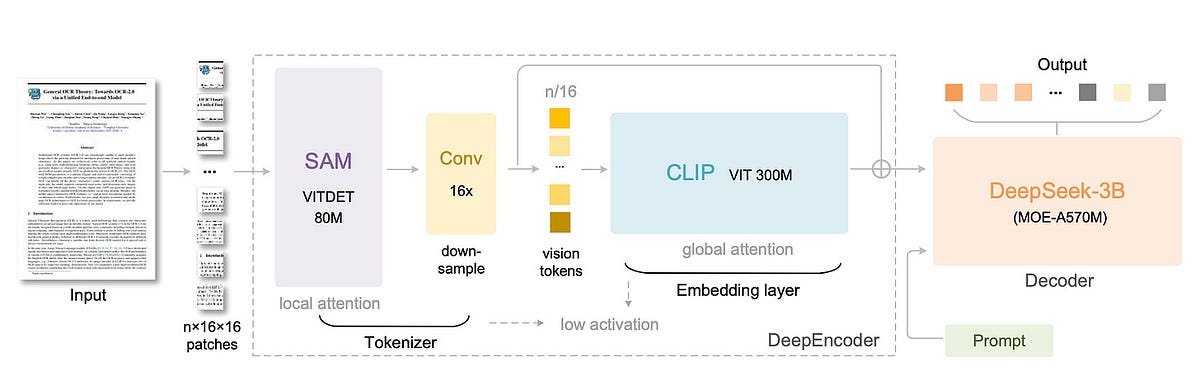
DeepSeek-OCR is structured as an end-to-end Vision-Language Model (VLM), consisting of two main components: a DeepEncoder and a DeepSeek3B-MoE decoder.
1. DeepEncoder: The Compression Engine
This is where the magic happens. The DeepEncoder's primary role is to take high-resolution document images and compress them into a minimal, manageable number of vision tokens while preserving crucial textual information. The DeepSeek team had to engineer this component from scratch because existing open-source encoders didn't meet their stringent requirements for efficiency and low activation memory at high resolutions. The DeepEncoder is a ~380M parameter model that achieves high compression ratios through a clever design:
Window Attention (SAM-base): An initial component processes a large number of visual patches with windowed attention, efficient for local context processing.
16x Token Compressor: A crucial convolutional compressor reduces thousands of initial patch tokens into just a few hundred vision tokens. This is the core mechanism for achieving the significant compression ratios.
Global Attention (CLIP-large): The compressed vision tokens then pass to a global attention component, integrating broader context and leveraging pre-existing knowledge from models like CLIP.
This serial connection of local and global attention, bridged by an aggressive compressor, ensures that the model can handle high-resolution inputs without exploding in memory while still generating a compact set of highly informative vision tokens.
2. DeepSeek3B-MoE-A570M Decoder
Once the DeepEncoder has done its job, the compressed visual representation is passed to the DeepSeek3B-MoE-A570M decoder. This is a compact language model, specifically designed to interpret these dense vision tokens and decode them back into coherent text. The fact that a relatively small LLM can accurately reconstruct text from such compressed visual data is a strong indicator of the efficacy of the vision tokens.
Performance and Compression Ratios
The numbers DeepSeek-OCR reports are compelling and illustrate the potential of this approach:
9-10x Text Compression: Achieves 96%+ OCR decoding precision. This means that content that would typically require 9-10 text tokens can be represented by a single vision token, with very high accuracy.
10-12x Compression: Maintains approximately 90% accuracy.
20x Compression: Even at a drastic 20x compression ratio, the model still manages around 60% accuracy.
These results, particularly at the 9-10x mark, are not just theoretical; they translate directly into practical benefits. On benchmarks like OmniDocBench, DeepSeek-OCR outperforms established models like GOT-OCR2.0 (which uses 256 tokens/page) using a mere 100 vision tokens. Against MinerU2.0 (averaging 6000+ tokens/page), DeepSeek-OCR uses fewer than 800 vision tokens to achieve superior results. Furthermore, it can generate training data for LLMs/VLMs at a staggering rate of 200,000+ pages per day on a single A100-40G GPU, highlighting its production readiness.
Beyond OCR: The Broader Implications for LLMs
- This work is more than just an advanced OCR system. It's a foundational step towards redefining how LLMs handle extensive content. The key takeaways for developers and researchers are significant:
- Addressing the Context Window Problem: The ability to represent massive amounts of textual information with dramatically fewer tokens directly alleviates the computational and memory burdens associated with long context windows in LLMs. This could unlock truly long-form document understanding and reasoning.
- Rethinking Input Modality: Andrej Karpathy's observation that "pixels might be better inputs to LLMs than text" resonates deeply here. If vision tokens are inherently denser and more efficient information carriers, it questions the long-held assumption that text is the optimal or only input modality for language models. We might be witnessing a shift towards models that 'see' rather than 'read' text for internal processing.
- New Avenues for Research: This paradigm opens up research into areas like historical document analysis (where visual fidelity is crucial), more robust memory mechanisms for LLMs, and even novel ways for models to learn from combined visual-textual datasets at scale.
- Practical Efficiency Gains: For real-world applications requiring large-scale document processing, data extraction, or content summarization, DeepSeek-OCR offers tangible cost and speed advantages. Generating training data at 200k+ pages/day is a significant throughput that directly impacts model development cycles.
While DeepSeek-OCR is presented as a "preliminary proof-of-concept," its results are anything but preliminary. It demonstrates a viable path towards making LLMs far more efficient and scalable in handling long-form text. For developers building systems that interact with vast textual data, this optical compression method represents a critical architectural consideration. We should be watching how this vision-centric approach evolves, as it might well become a standard component in the next generation of efficient, long-context AI systems.
The future of LLM input might not be about more text tokens, but fewer, richer vision tokens.