Demystifying Agentic AI: A Developer's Practical Perspective
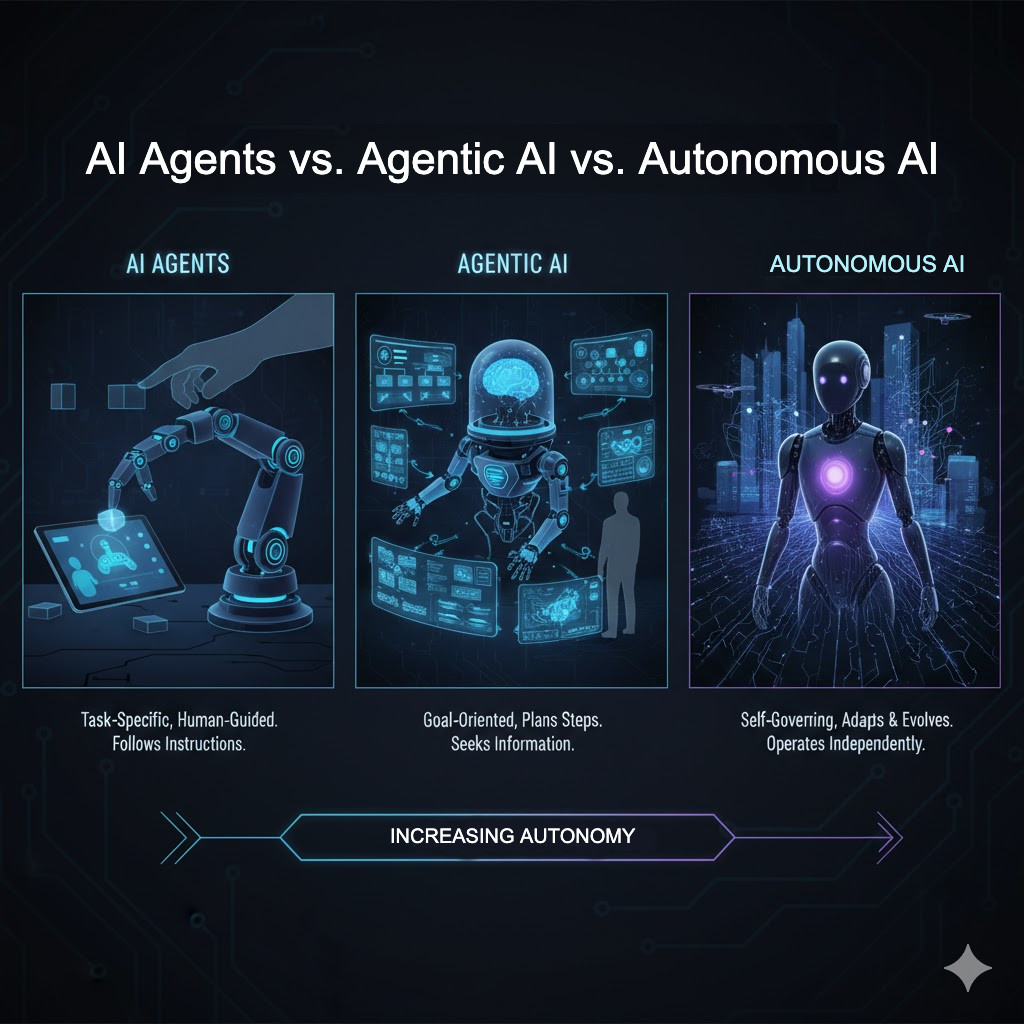
The concept of artificial intelligence has evolved significantly, moving from reactive chatbots and assistive copilots to something far more autonomous: agentic AI. As developers, it's crucial we understand this shift, not as hype, but as a practical new paradigm for building systems that can genuinely think ahead, make decisions, and execute multi-step workflows without constant human prompting.
What Exactly Are We Talking About? Defining Agentic AI
At its core, an AI agent is a software system designed to perform tasks autonomously on behalf of a user or another system. Unlike the AI tools many of us are familiar with – those that answer questions or offer suggestions – agentic platforms empower AI to formulate goals, devise plans, and take actions across various systems to achieve those goals. Think of it as moving from an assistant who waits for instructions to one who anticipates needs and takes initiative.
These agents go beyond mere natural language processing. They are capable of decision-making, complex problem-solving, interacting with external environments, and executing a sequence of actions. This is a fundamental departure from earlier automation approaches like Robotic Process Automation (RPA) or simple LLM assistants, which typically rely on rigid, predefined workflows. Agentic AI, by contrast, observes its environment, processes information, and learns from the outcomes of its decisions, allowing it to adapt and adjust its course in real-time.
Under the Hood: The Agentic Architecture
For an AI agent to exhibit this level of autonomy, it relies on a sophisticated internal architecture. This structure is what enables it to perceive its surroundings, process incoming data, make informed decisions, and ultimately take meaningful action. Key interconnected components facilitate this:
Perception: How the agent gathers information from its environment, be it text, sensor data, or API responses.
Information Processing: Analyzing perceived data to understand context, identify patterns, and extract relevant insights.
Decision-Making: Utilizing processed information to select the best course of action from a set of possibilities, often involving reasoning and planning.
Collaboration: In multi-agent systems, this involves communicating and coordinating with other agents to achieve shared or complementary goals.
Action Execution: Translating decisions into concrete actions, often through integrating with external tools, APIs, or existing systems.
Learning: Adapting and improving performance based on past experiences and outcomes, refining future decision-making and planning.
This agentic architecture is not just theoretical; it's the blueprint for how AI models are automated within these systems, shaping the entire workflow structure. Multi-agent systems, where several AI agents collaborate, further extend these capabilities, allowing for parallel task execution and specialized roles within a larger objective.
Empowering Developers: Agentic Frameworks
Building an autonomous agent from scratch is a significant undertaking. This is where agentic frameworks become indispensable. These software toolkits provide the foundational components and abstractions necessary to develop, deploy, and manage AI agents more efficiently. They offer pre-built modules for crucial aspects like perception, reasoning, action, and memory management.
From a developer's perspective, the benefits of leveraging these frameworks are substantial:
- Task Decomposition and Autonomy: Frameworks enable agents to break down complex goals into manageable sub-tasks and make independent decisions on how to execute them, reducing the need for explicit scripting of every step.
Built-in Memory and Context Handling: Agents can retain relevant information across sessions, allowing for more coherent, personalized, and long-term task performance. This persistent memory is critical for complex, ongoing interactions.
Multi-Agent Coordination: Many frameworks offer robust support for communication and collaboration between multiple agents, facilitating complex workflows that require distributed intelligence.
Tool and API Integration: A core strength of agents is their ability to interact with real-world systems. Frameworks streamline the connection to external tools, APIs, and databases, vastly expanding the agent's action capabilities beyond just generating text.
Modularity and Reusability: Agent behaviors, tools, and memory modules are typically designed as reusable components, accelerating development cycles and simplifying maintenance efforts.
Support for Iteration and Self-Correction: Agents built with these frameworks can evaluate the outcomes of their actions, revise their plans, and even retry failed steps, making them more resilient in dynamic or unpredictable environments.
- Scalable Architecture: Frameworks often provide the underlying infrastructure to manage large-scale agent systems, supporting everything from individual personal assistants to enterprise-level automation.
While frameworks abstract much of the complexity, the performance of agentic AI systems is still heavily dependent on the underlying data infrastructure. High-quality, real-time data is the lifeblood of perception and decision-making for these agents. Robust open-source technologies like Apache Kafka for real-time ingestion, Apache Cassandra or PostgreSQL for data storage, and OpenSearch for retrieval are often the unsung heroes providing the scalable, efficient, and reliable backbone for agentic operations.
The Pragmatic View: Challenges and Responsible Development
While the capabilities of agentic AI are impressive, it's vital to maintain a pragmatic perspective. This isn't a silver bullet that eliminates all human effort. In fact, human oversight remains critical. We, as developers and system architects, are still responsible for defining the goals, providing the necessary context and information, and establishing the guardrails within which the agents operate. Regular monitoring and check-ins are essential to ensure the AI is performing as expected and adapting appropriately.
Governance is another significant consideration. As AI agents become more autonomous and integrated into critical workflows, establishing clear processes, standards, and guardrails becomes paramount to ensure these systems are safe, ethical, and compliant with regulations. This applies to broad enterprise adoption, where measuring ROI and overcoming deployment barriers requires a practical framework for successful integration.
Agentic AI also presents advanced solutions like Agentic RAG (Retrieval Augmented Generation). Here, AI agents enhance traditional RAG systems by enabling large language models to conduct more sophisticated information retrieval from multiple sources and handle complex, multi-step information-gathering workflows, significantly improving the quality and depth of generated responses.
Looking Ahead
Agentic AI and autonomous agents are clearly poised to redefine automation and interaction with digital systems. For developers, this represents a powerful new set of tools to build more intelligent, adaptive, and efficient applications. Understanding their underlying architecture, leveraging effective frameworks, and maintaining a focus on responsible development will be key to harnessing their full potential and integrating them successfully into our increasingly complex technical landscapes. The future of computing is certainly becoming more agent-driven, and our role is to engineer it thoughtfully.