Engineering Autonomous AI Agents for Production Realities
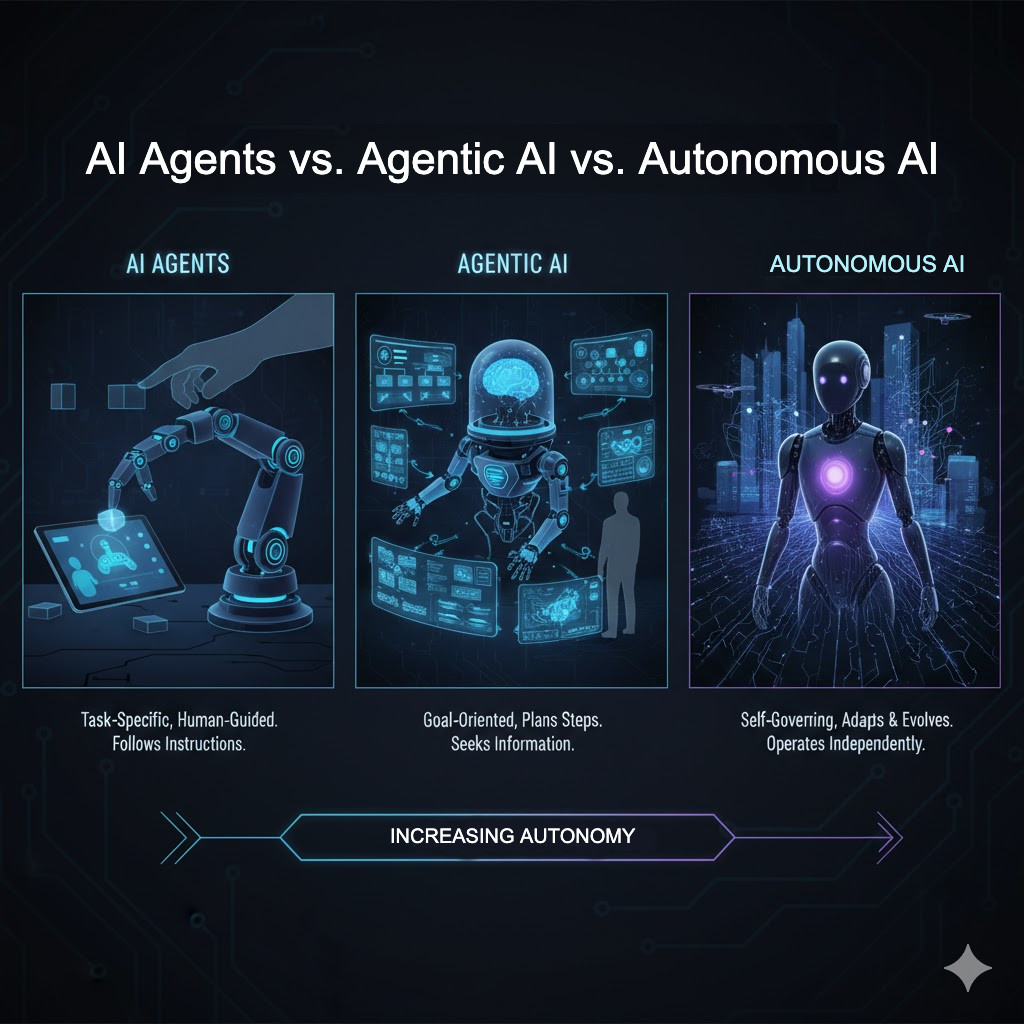
The AI landscape evolves at a blistering pace, but as software engineers, we learn to distinguish between genuine paradigm shifts and ephemeral hype. Over the past year, the concept of 'Agentic AI' or 'Autonomous AI Agents' has moved decisively into the former category. It’s no longer just about sophisticated chatbots or intelligent copilots; we're talking about systems that perceive, reason, plan, act, and learn with minimal human intervention, pursuing defined goals rather than merely responding to prompts.
For too long, our interactions with AI models felt like an expensive autocomplete. We'd feed it an input, get an output, and then have to articulate the next logical step ourselves. An agentic system changes this fundamental interaction: you give it a goal, and it orchestrates the entire sequence of operations to achieve it. It's the difference between asking a junior developer for a specific code snippet and delegating an entire feature implementation, trusting them to break it down, use the right tools, and deliver a working solution.
What Actually Makes an AI 'Agentic'?
The distinction is crucial. Many systems are labeled 'agentic' when they are, at best, multi-turn chatbots with better memory. True agentic behavior is characterized by several non-negotiable ingredients:
Goal-Directed Autonomy: The system is given a high-level objective, not a prescriptive series of commands. It autonomously determines the necessary steps.
Multi-Step Planning: It can decompose complex goals into a sequence of actionable sub-tasks and dynamically adjust its plan based on intermediate outcomes.
Tool Use: Agents integrate with and leverage external systems, APIs, databases, or even other agents to perform tasks that go beyond their core reasoning capabilities.
Memory and State Management: They maintain context across interactions, learning from past actions and applying that knowledge to future decisions without restarting from a blank slate.
Feedback Loops: Agents continuously observe the results of their actions, evaluate their effectiveness against the goal, and adjust their behavior or plan accordingly.
Miss any of these, and what you have is a highly capable, yet still fundamentally reactive, piece of software.
The Architecture Beneath the Autonomy
Behind every working agent lies a robust, cyclical architecture. Most practical agent implementations share a common set of components, forming a continuous 'sense, decide, act, observe, update' loop:
Perception: This is the agent's input layer, allowing it to ingest data from diverse sources – APIs, documents, databases, logs, or real-time streams. The quality and freshness of this data are paramount; an agent reasoning over stale information is just a slow, error-prone chatbot with extra steps.
Reasoning and Planning: This is the 'brain' of the agent, where it interprets perceived data, evaluates its current state against its goal, and formulates a multi-step action plan. This often involves complex logical deductions and strategic decision-making.
Memory: Agents need both short-term context (for the current task) and long-term knowledge (learned patterns, previous successes/failures) to operate effectively. This state persistence prevents redundant work and enables more sophisticated, evolving behaviors.
Tool Use: The ability to call external services, enterprise systems (like CRMs or ERPs), or even other specialized agents is what empowers an agent to move beyond purely cognitive tasks and effect change in the real world.
Feedback Loops: After taking an action, the agent observes the outcome, compares it to the expected result, and uses this feedback to refine its understanding, adjust its plan, or even modify its internal reasoning processes. This is where true learning and adaptation occur.
Infrastructure Matters More Than You Think
While much of the early attention on AI focused on model quality and GPU-accelerated inference, agentic AI introduces a critical shift: infrastructure becomes as important as the model itself. Autonomous agents spend a significant portion of their runtime on CPU-bound work. This includes complex planning, orchestration of multi-step workflows, sandboxed execution of external tools, and dynamic code generation.
As GPU capabilities continue to accelerate, the CPU often becomes the bottleneck for agent performance. Ensuring your underlying data infrastructure can provide fresh, relevant information at speed is also non-negotiable. A brilliant planner operating on outdated data is destined to fail. This isn't just a modeling challenge; it's an end-to-end infrastructure problem requiring a holistic approach.
Where Agents Create Real Business Value (And Where They Fail)
The strongest use cases for autonomous agents are not found in isolated task-level drafting or content generation – those are often better served by simpler copilot models. The real value emerges from end-to-end workflow completion. Companies that have seen significant returns from agentic AI have embedded these systems into specific, revenue-driving, or efficiency-critical workflows, rather than deploying generic, horizontal tools.
Common areas where agents are demonstrating success include:
Customer Service & Contact Centers: Handling complex inquiries, troubleshooting, and escalating issues autonomously.
Sales & CRM Automation: Qualify leads, update records, personalize outreach, and manage follow-ups.
Financial Operations: Automated reconciliation, fraud detection, and transaction processing.
Supply Chain & Logistics: Optimizing routes, managing inventory, and predicting demand.
Cybersecurity: Proactive threat detection, incident response, and vulnerability management.
Software Testing & DevOps: Automating test case generation, bug triaging, and deployment workflows.
Conversely, a significant number of agentic AI pilots – reportedly around 88 percent – fail to reach production. The primary reason? The chasm between curated demos and the messy reality of production enterprise systems. The useful questions have shifted from 'can the model do X?' to 'how does this agent integrate with our legacy ERP at 2 a.m. when things break?', 'who is accountable for its actions?', and 'how do we govern its decision-making boundaries?'
The Multi-Agent Horizon (Proceed with Caution)
An emerging trend involves orchestrating multiple specialized agents to collaborate on more complex goals. Concepts like Microsoft's multi-agent orchestration in Copilot Studio and Salesforce's Agentforce reflect this direction. While undeniably powerful, a word of caution is warranted.
For most enterprises, reaching for multi-agent systems too early is a pitfall. If you struggle to govern a single agent's identity, data boundaries, and debugging processes, attempting to manage a symphony of ten interconnected, autonomous agents will multiply your problems exponentially. The pragmatic approach remains to start with one narrow, well-defined workflow and a single, focused agent. Demonstrate its value, understand its failure modes, and build your governance muscle before scaling up to multi-agent complexity.
Getting Started Today
Despite the complexities, building your first agentic system is more approachable than ever. Frameworks have matured, and APIs are cleaner, abstracting away much of the underlying LLM wrangling. The developer community is actively building tools that facilitate perception, planning, and tool integration.
The critical step is to identify a bottleneck in an existing workflow that is ripe for automation. Start small, define clear boundaries, provide the agent with the necessary tools, and meticulously monitor its performance and outputs. Embrace an iterative development cycle, learning from each deployment.
Agentic AI is not a magic bullet, nor is it a set-it-and-forget-it solution. It demands rigorous architectural design, a deep understanding of your operational context, and a commitment to robust governance. But for those willing to engage with its nuances, autonomous agents represent a profound opportunity to build genuinely transformative software systems that move beyond reactivity to proactive, goal-driven execution.