GPT-5.6 Sol: A Pragmatic Look at Performance and Production Costs for Developers
The competitive landscape for large language models is relentless, and as developers, we're constantly sifting through marketing noise to find tools that genuinely move the needle. OpenAI's recent release of the GPT-5.6 family—Sol, Terra, and Luna—demands our attention, not just for its promise, but for its measurable impact on performance and, crucially, cost.
At the core, what developers need are models that perform reliably and affordably. GPT-5.6 Sol, positioned as the flagship, has undergone extensive benchmarking, and the results are compelling enough to warrant a serious re-evaluation of our current LLM stacks. It's not just about raw intelligence; it's about practical utility in the development lifecycle.
Sol's Dominance Across Developer Benchmarks
Independent evaluations paint a clear picture. Claire Vo's "How I AI vibe benchmark," which spans critical development artifacts like PRDs, prototypes, wireframes, debugging, and agentic voice, saw Sol emerge as a significant victor against established models like Claude Fable 5, Sonnet 5, and even its siblings, Terra and Luna. This isn't a theoretical win; it's a direct indication of Sol's effectiveness in generating practical, usable outputs for common engineering tasks.
For more structured intelligence assessments, the Artificial Analysis Intelligence Index provides further evidence. GPT-5.6 Sol, operating at its maximum reasoning effort, scores just a single point below Claude Fable 5. While Fable 5 still holds a slight edge in raw intelligence on this specific index, the narrative shifts dramatically when we consider the full context of cost and speed.
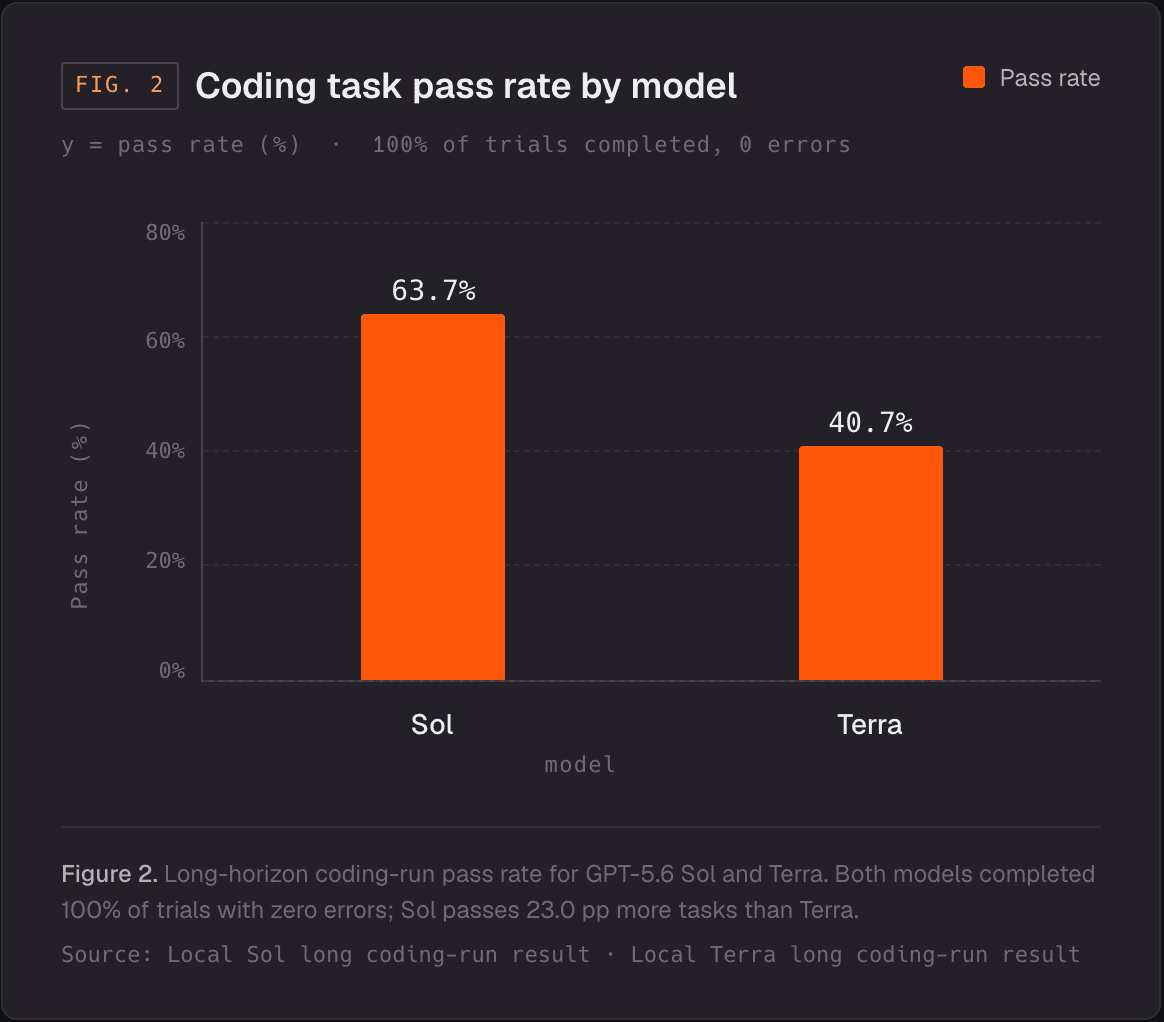
Where Sol truly begins to shine for the engineering community is in specialized coding benchmarks. The Artificial Analysis Coding Agent Index, which integrates models with agentic harnesses and evaluates across DeepSWE, Terminal-Bench v2, and SWE-Atlas-QnA, positions GPT-5.6 Sol (max reasoning with Codex) as the undisputed leader. Scoring 80 points, it outperforms Fable 5 by 2.8 points. This means less debugging, more effective code generation, and better handling of long-horizon engineering workflows—a substantial boost to developer productivity.
Beyond just coding, Sol also makes strides in complex professional workflows. On Agents' Last Exam, an evaluation of long-running tasks across 55 fields, Sol sets a new high of 53.6, eclipsing Claude Fable 5 by a substantial 13.1 points. Even at medium reasoning, Sol still beats Fable 5 by 11.4 points. This indicates a higher degree of robustness and capability in sustained, multi-step agentic operations.
While Fable 5 still leads in some analytical quality metrics on benchmarks like AA-Briefcase, Sol demonstrates a superior "Presentation Elo," meaning its outputs across various file types, including visual formats like PowerPoint and Excel, are remarkably more visually attractive. This isn't a trivial detail; for documentation, presentations, or reporting generated by an AI, aesthetic quality contributes directly to perceived professionalism and clarity.
It's also worth noting that the entire GPT-5.6 family demonstrates strong performance. Terra and Luna, while positioned for different efficiency targets, still outperform Fable 5 in several key areas, highlighting OpenAI's concerted effort across the entire model line.
The Critical Factor: Cost Efficiency in Production
Benchmarks are compelling, but for deployment in real-world applications, cost is often the deciding factor. This is where GPT-5.6 Sol establishes a new frontier, offering what OpenAI terms "stronger performance per dollar." The data supports this claim decisively.
On the Artificial Analysis Intelligence Index, GPT-5.6 Sol (max reasoning) delivers intelligence comparable to Claude Fable 5 but at approximately one-third of the cost. This translates directly to significant savings for any organization integrating these models into production workflows. For many, this cost reduction can unlock new use cases or enable scaling that was previously financially prohibitive.
Looking at the stated API pricing, Sol comes in at $5 per million input tokens and $30 per million output tokens. Compare this to its competition, and Sol consistently proves to be more economical. But the cost story doesn't end with Sol. For applications with tighter budget constraints or where absolute frontier intelligence isn't always paramount, GPT-5.6 Terra ($2.5/$15 per million tokens) and Luna ($1/$6 per million tokens) offer even more aggressive cost reductions. Luna, for instance, can match or exceed the intelligence of models like GLM-5.2 and Gemini 3.5 Flash at a significantly lower cost, making advanced AI capabilities accessible across a broader spectrum of projects.
OpenAI has also introduced a notable change with cache-write pricing for the GPT-5.6 models. Cache writes now incur a cost premium, priced at 1.25 times the input token rate, while cache reads still benefit from a 90% discount. This shift aligns OpenAI with practices seen from other providers and reflects the underlying memory and processing costs associated with committing tokens to memory. Developers must now be more deliberate in their caching strategies, optimizing for reuse to maximize efficiency. This encourages a more thoughtful approach to prompt engineering and state management in agentic workflows.
Furthermore, Sol's inherent token efficiency—using fewer output tokens than most comparable models—is a silent contributor to its cost-effectiveness. Less output means fewer tokens billed, regardless of the per-token price.
Practical Applications and Developer Utility
The real test for any new model is how it translates into tangible developer utility. Sol's improved "computer use and design judgment" position it as a more polished and capable collaborator. Anecdotal evidence from developers highlights Sol's ability to tackle complex, multi-step problems that other models struggle with. For example, building a fully gamified homework tracking app using Codex in a single shot, or automating browser interactions to process hundreds of LinkedIn replies, are compelling demonstrations of Sol's enhanced agentic capabilities. This ability to coordinate tools, process intermediate results, and self-correct with fewer model round trips represents a significant leap forward for building sophisticated AI agents.
The new "Ultra" setting for Sol, designed to coordinate multiple agents across parallel workstreams, points to a future where complex tasks can be decomposed and executed with unprecedented efficiency. This capability is critical for tackling large-scale projects requiring distributed AI intelligence.
While Sol is a strong contender, it's worth acknowledging that the right tool for the job still matters. For specific nuances of "agentic voice" tasks, some developers might still find Sonnet 5 to be their preferred choice, highlighting the evolving and specialized nature of the LLM ecosystem. However, for a broad range of development tasks, particularly those involving coding, reasoning, and complex automation, GPT-5.6 Sol is demonstrably superior in both output quality and cost performance.
The Evolving Developer Toolkit
GPT-5.6 Sol, along with Terra and Luna, represents a significant evolution in the LLM space. It's not just an incremental update; it's a strategic move towards delivering higher intelligence with greater efficiency. For software engineers and teams, this means a renewed opportunity to build more capable, more reliable, and more cost-effective AI-powered solutions.
These models compel us to revisit our existing integrations and consider where GPT-5.6 can provide a tangible advantage. Whether it's for complex code generation, intricate agentic workflows, or simply reducing operational costs, Sol has firmly set a new benchmark for what we can expect from frontier AI models. The LLM landscape remains dynamic, but GPT-5.6 Sol has undeniably raised the bar for practical, cost-aware development.