GPT-5.6 Sol Max Reasoning: What It Means for Developer Workflows
OpenAI recently rolled out its GPT-5.6 model family, with Sol as the new flagship, flanked by Terra and Luna. While new model releases are frequent, what stands out with Sol is the introduction of "max reasoning effort" – a control that fundamentally changes how the model approaches complex problems. As developers, our interaction with large language models is constantly evolving, and this particular feature warrants a closer look, moving beyond the marketing gloss to understand its practical implications for our daily work.
The 'Max Reasoning Effort' Paradigm Shift
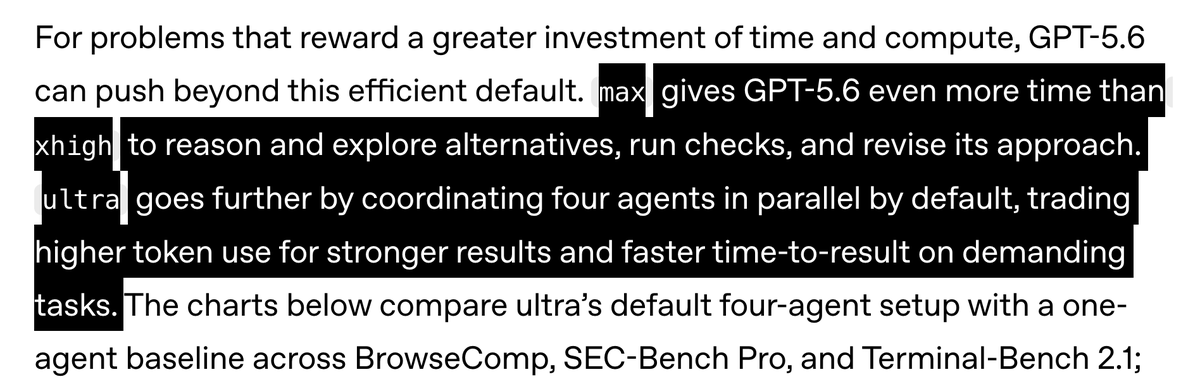
The concept of "max reasoning effort" is not just about throwing more compute at a problem. It's about enabling the model to engage in a more iterative and reflective problem-solving process. Essentially, it gives Sol "more time to think" on a given problem. This isn't merely a speed setting; it's a directive for the model to explore alternatives, run internal checks, revise its approach, and, if necessary, coordinate multiple internal agents across parallel workstreams to tackle complex tasks.
Think of it less like a faster query and more like instructing a highly capable colleague to "take your time, explore all angles, and ensure the solution is robust." In traditional LLM interactions, we often battle with models that rush to a conclusion, sometimes confidently wrong or missing nuances. Max reasoning effort aims to mitigate this by allowing Sol to engage in a deeper, more deliberate internal thought process before presenting its output. For developers working on intricate system designs, debugging elusive issues, or crafting complex algorithms, this shift from immediate response to considered deliberation is significant. It implies a model that can potentially catch its own mistakes, refine its understanding, and deliver more reliable, ready-to-use results.
Performance and Efficiency for Developers
The numbers provided by OpenAI are compelling. On the Artificial Analysis Coding Agent Index, GPT-5.6 Sol with max reasoning achieved a state-of-the-art score of 80, outperforming previous frontier models. What's more critical from a developer's perspective is how it achieves this: using less than half the output tokens, taking less than half the time, and costing approximately one-third less. This isn't just about raw intelligence; it's about efficiency. More successful work for the same expenditure, or comparable results at a lower total cost.
This efficiency extends to complex agentic workflows. Evaluations like "Agents' Last Exam," which assesses long-running professional tasks across 55 fields, show Sol with max reasoning setting a new high. It can write and run lightweight programs, coordinate tools, process intermediate results, and monitor progress, all while requiring fewer tokens and fewer model round trips. For developers building autonomous agents or integrating AI into complex CI/CD pipelines, this translates directly to more performant and cost-effective solutions. The ability for the model to "inspect, refine, and deliver ready-to-use results" suggests a reduced need for post-processing or extensive human oversight.
Collaboration vs. Delegation: The Developer's New Workflow
One of the most insightful observations about Sol is its aptitude for collaboration rather than just pure delegation. Other powerful models might excel at taking a high-level, ambiguous assignment and running with it autonomously, effectively delegating a large chunk of work away from the developer. Sol, particularly with max reasoning, appears to shine in scenarios where a developer wants to remain close to the work, iterating and guiding the outcome as it evolves.
Imagine a complex refactoring task. Instead of handing off the entire codebase, you might engage Sol with max reasoning to explore different architectural patterns, propose refactorings for a specific module, identify potential pitfalls, and then refine those suggestions based on your immediate feedback. It's fast enough to keep pace with an active developer, resourceful enough to pull in necessary context, and persistent when initial approaches hit roadblocks. The description of Sol as a "Porsche" for day-to-day work, compared to other models being a "warp drive" for galaxy-spanning tasks, perfectly encapsulates this nuance. Most of our development challenges are not "galaxy-spanning" but require nuanced, iterative problem-solving "around town." This blend of speed, intelligence, and steerability makes it an ideal partner for interactive development, debugging, and ideation.
- For instance, when designing a new API, a developer might use max reasoning to:
Brainstorm alternative endpoint structures, considering edge cases.
Suggest robust error handling mechanisms tailored to specific response types.
- Generate comprehensive test cases that probe the API's behavior under various loads and inputs.
This isn't about giving the AI a blank check; it's about using its enhanced reasoning to accelerate and improve the quality of your own iterative design process.
Under the Hood
While OpenAI doesn't release all the internals, the concept of "reasoning tokens" is worth noting. Reasoning tokens reflect the model's internal thinking before a response, distinct from prompt tokens (input) and completion tokens (output). This hints at a more granular cost model and potentially greater transparency into the computational effort expended during the "max reasoning" phase. A million-token context window and 128,000 maximum output tokens provide ample room for tackling large codebases, extensive documentation, or complex multi-file projects, which is crucial for deep reasoning tasks. These are not just arbitrary numbers; they are the bedrock upon which sophisticated agentic behavior and extended, deliberate thought processes are built.
Practical Implications and Future Outlook
What does this mean for our tooling and architectures? For one, it encourages the development of more interactive AI-powered development environments. Imagine IDEs where Sol with max reasoning is not just suggesting code completions, but actively identifying architectural smells, proposing robust design patterns, and even helping you navigate complex legacy codebases by offering reasoned explanations and refactoring strategies.
The robust safeguards built into GPT-5.6 are also a critical piece of the puzzle. For production systems, the confidence that models are resilient against misuse, backed by extensive red teaming and real-time checks, is paramount. This enables developers to integrate these advanced capabilities into mission-critical applications with greater assurance, knowing that the intelligence is paired with responsible deployment.
The "ultra" setting, which coordinates multiple agents, further points to a future where AI isn't just a single monolithic entity but an orchestrator of specialized sub-agents, each contributing to a complex task under the umbrella of max reasoning. This opens up avenues for more sophisticated, multi-stage problem-solving systems where the developer acts as the high-level architect, guiding the AI's internal "team" of agents.
Conclusion
GPT-5.6 Sol's "max reasoning effort" is more than just a performance bump; it's a signal towards a new era of AI collaboration. It shifts the paradigm from simply generating output to engaging in deeper, more deliberative problem-solving. For staff software engineers, this means access to an AI partner that can not only accelerate daily tasks but also elevate the quality of complex design, debugging, and development work. While we should always maintain a critical eye on new technologies, the promise of an LLM that can genuinely "think" more deeply, efficiently, and effectively, represents a compelling advancement in our toolkit. It's an invitation to build more sophisticated, more reliable, and ultimately, more intelligent software.