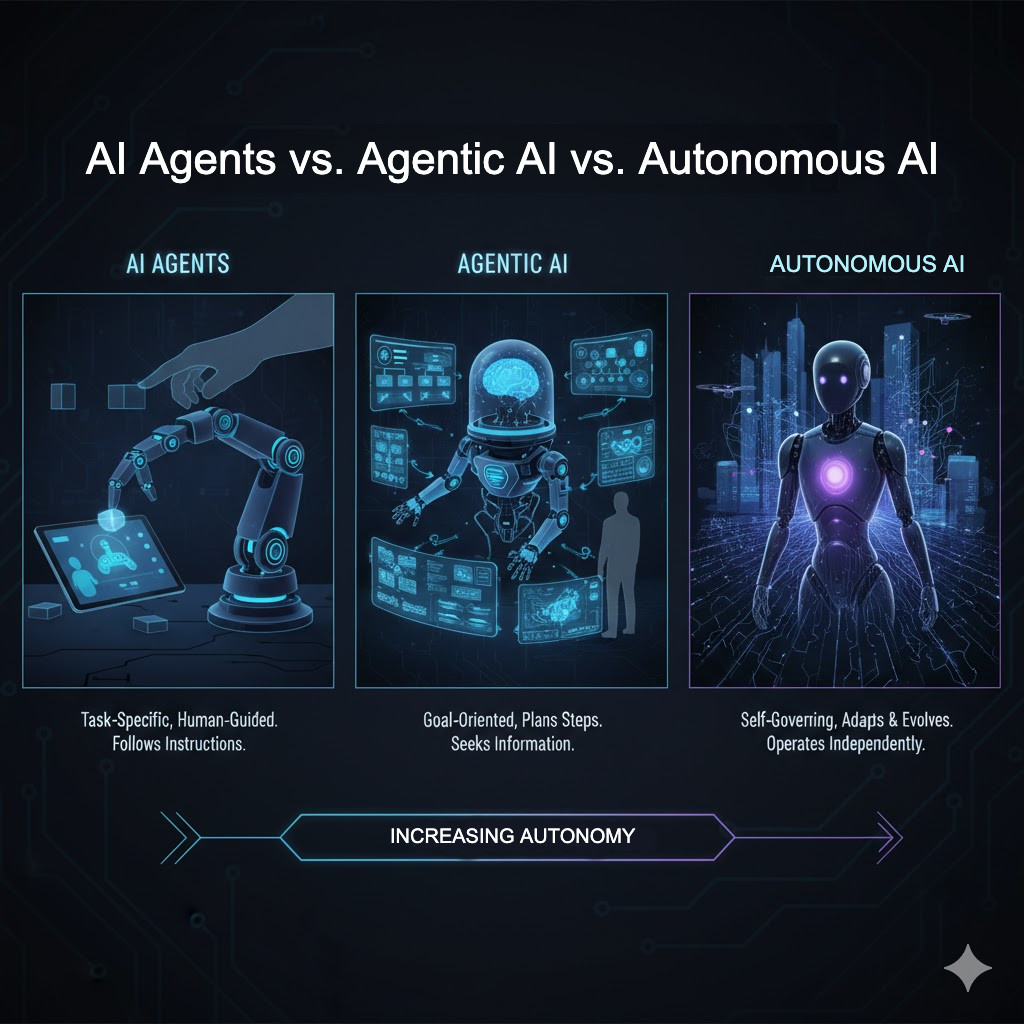
Navigating Agentic AI: Beyond the Hype to Production Reality
The conversation around AI has evolved, shifting from large language models as sophisticated chatbots to the far more ambitious concept of 'agentic AI' or 'autonomous agents'. For many of us in the trenches, the promise is compelling: software systems capable of perceiving environments, reasoning through problems, planning multi-step actions, utilizing tools, and executing work across enterprise systems with minimal human intervention. This isn't just about generating text; it's about goal-directed execution, where the system decides what's next and acts on its own initiative.
The Core Mechanics of Autonomy
At its heart, an AI agent functions through a continuous loop: sense, decide, act, observe, and update. This loop is powered by several interconnected components:
- Perception: Ingesting data from various sources—APIs, documents, databases, live streams—to understand its environment.
Reasoning and Planning: Leveraging sophisticated models to decide the most appropriate next step to achieve a defined goal, based on the current context.
Memory: Maintaining state across interactions, preventing the agent from operating in a vacuum and allowing for long-horizon tasks.
Tool Use: The ability to call external services, interact with enterprise systems, or even coordinate with other agents to perform specific functions.
- Feedback Loops: Crucial for learning and adaptation, allowing the agent to check outcomes and adjust its behavior for future tasks.
When we talk about 'agentic architecture,' we're referring to how these components are structured and designed to automate AI models within a larger system. It's about building frameworks that enable complex, often multi-stage workflows.
The Allure of Long-Horizon Agents
One of the most exciting developments is the emergence of long-running agents. These aren't your typical single-turn prompts; they can operate for hours, days, or even months, tackling complex tasks like internal software development workflows or multi-day research projects with minimal human oversight. This shift from simple request-response to sustained, goal-oriented operation means agents behave more like distributed systems. And herein lies a significant challenge: distributed systems demand robust orchestration, clear identity management, and stringent context discipline – capabilities that many enterprises are still building out for human-managed systems, let alone autonomous ones.
The Production Reality: A Chasing Game
While three-quarters of enterprise leaders express interest in adopting agentic AI, the reality on the ground is stark. Only a small minority have moved beyond