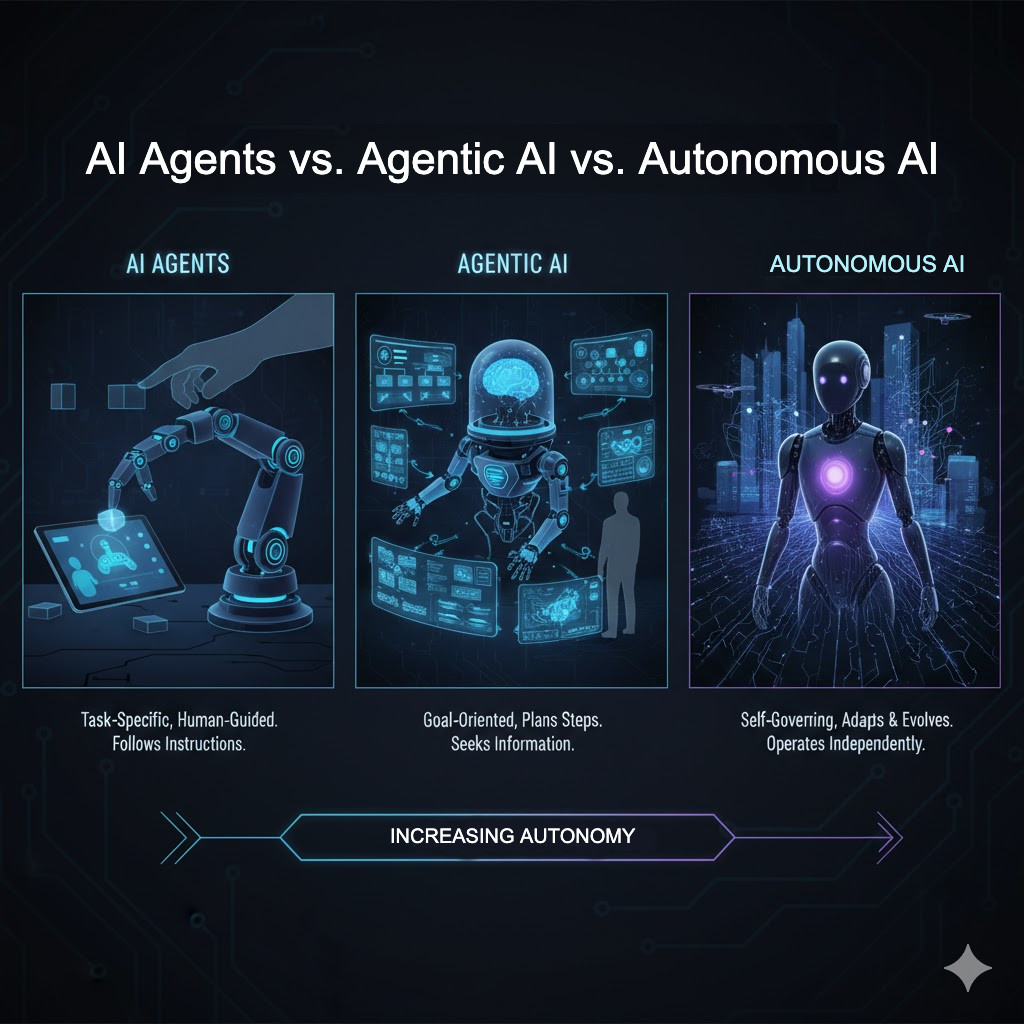
Navigating Agentic AI: Frameworks and the Path to Autonomous Systems
For developers, the concept of AI agents marks a significant evolution in how we conceive and build intelligent software. We're moving past the paradigm of models that merely process data to systems that can autonomously understand, plan, and execute tasks. These aren't just sophisticated chatbots; they are goal-driven programs capable of designing their own workflows and leveraging tools to achieve objectives on behalf of a user or another system.
At its core, an AI agent operates on a loop of perception, processing, decision-making, action, and learning. It perceives its environment, processes that information, decides on the next course of action, performs it, and ideally, learns from the experience to improve future performance. This cyclical operation is what gives agents their dynamic, adaptive nature, allowing them to tackle a wide range of functionalities beyond traditional natural language processing, including complex problem-solving and interaction with external systems.
The Necessity of Agentic Frameworks
Building such autonomous systems from scratch introduces considerable complexity. This is where agentic AI frameworks become indispensable. They are software toolkits designed to simplify the creation, deployment, and management of AI agents by providing pre-built components and structures. Think of them as the foundational scaffolding that allows us to build intricate, goal-driven systems without reinventing every wheel.
These frameworks abstract away much of the underlying complexity, offering developers crucial capabilities:
- Task Decomposition and Autonomy: Agents can break down large, ambiguous goals into smaller, manageable sub-tasks and make independent decisions without constant human oversight.
Persistent Memory and Context Management: A critical feature, enabling agents to retain relevant information across sessions, improving coherence, personalizing interactions, and maintaining context over long-term engagements. This is more than just a short-term memory buffer; it's about building a robust understanding of past interactions and outcomes.
Multi-Agent Coordination: Many real-world problems benefit from collaboration. Frameworks increasingly support the orchestration of multiple AI agents working collectively, each specializing in different aspects of a task, leading to more robust and efficient solutions. This unlocks parallel task execution and the ability to combine diverse expert agents.
Tool and API Integration: To interact with the 'real world,' agents need to use tools. Frameworks provide mechanisms to connect agents to external APIs, databases, and other software, allowing them to perform actions far beyond just generating text—like sending emails, querying databases, or manipulating files.
Modularity and Reusability: Agent behaviors, tools, and memory modules are often designed as reusable components, accelerating development cycles and simplifying maintenance efforts.
Iteration and Self-Correction: For an agent to be truly autonomous, it needs to evaluate its outcomes, revise its plans if necessary, and retry failed steps. Frameworks offer support for these self-correction mechanisms, making agents more resilient in dynamic and unpredictable environments.
- Scalable Architecture: From personal assistants to enterprise-level automation, frameworks are designed to manage agent systems of varying scales, providing the necessary infrastructure for growth.
Popular frameworks emerging in this space include CrewAI, LangGraph, AutoGen, LlamaIndex, DSPy, and Microsoft Semantic Kernel, with new entrants like Google's Agent Development Kit (ADK) focusing on enterprise-scale solutions. Each offers varying strengths for single-agent, multi-agent orchestration, tool integration, and data retrieval, allowing developers to choose based on project requirements.
The Unseen Backbone: Data Infrastructure
It's easy to get caught up in the allure of autonomous decision-making, but an agentic system is only as powerful as the data infrastructure supporting it. Agents rely heavily on a continuous flow of high-quality data to perceive their environment, learn from context, and execute decisions. Without a robust backend, even the most sophisticated agents will encounter bottlenecks, memory loss, or latency issues that cripple their performance.
This necessitates scalable, efficient, and reliable data infrastructure. Open-source technologies like Apache Kafka for real-time data ingestion and processing, Apache Cassandra or PostgreSQL for persistent memory and structured data storage, and OpenSearch or ClickHouse for rapid search and analytics become critical foundations. Autonomous agents often operate in dynamic environments where milliseconds count, making real-time data pipelines non-negotiable.
Agentic RAG: A Practical Leap Forward
One immediately impactful application of agentic principles is in Retrieval Augmented Generation (RAG). Traditional RAG systems often retrieve information from a predefined set of sources and pass it directly to a Large Language Model (LLM). Agentic RAG, however, empowers the LLM itself to act as an agent, dynamically conducting information retrieval from multiple, diverse sources, handling more complex queries, and even refining its search strategy based on initial results. This capability significantly enhances the accuracy and depth of generated responses, especially for nuanced or multi-faceted questions.
Governance and Responsible Development
With increased autonomy comes increased responsibility. As developers, we cannot overlook the processes, standards, and guardrails necessary to ensure agentic systems are safe and ethical. This involves establishing robust AI governance frameworks from the outset, addressing concerns around bias, transparency, accountability, and the potential for unintended consequences. The ability of agents to make decisions and take actions independently necessitates a proactive approach to regulation and ethical design.
Scaling for Enterprise ROI
For enterprises, the promise of agentic AI lies in measurable ROI through enhanced productivity and automation. However, scaling agentic AI across an organization presents its own set of challenges, including integrating with legacy systems, managing complexity, and clearly defining how impact will be measured. A practical framework for enterprise-wide adoption must address these barriers, focusing on pilot programs, iterative development, and a clear path to production readiness.
Looking Ahead
Agentic AI and autonomous agents are not just theoretical constructs; they are rapidly becoming a tangible component of the software landscape. As developers, understanding their architecture, leveraging robust frameworks, and building with an eye towards scalable infrastructure and responsible governance will be key to unlocking their full potential. This isn't just about making models smarter; it's about enabling software to genuinely take initiative, adapt, and operate with a level of autonomy that fundamentally changes how we build and interact with computing systems.