Navigating GPT-5.6 Tiers: Practical Cost Efficiency with Terra and Luna
The landscape of large language models is evolving rapidly, and OpenAI's GPT-5.6 series represents a significant shift from a monolithic model approach to a tiered system. With the introduction of Sol, Terra, and Luna, engineering teams now face a more nuanced decision-making process than simply picking the 'best' model. The practical challenge is identifying which tier delivers the most value for specific tasks, especially when cost efficiency and performance are critical.
At the top, we have Sol, the flagship. It’s designed for the most demanding, long-horizon coding tasks, complex reasoning, and scenarios where persistence across files, tests, and iterative fixes is paramount. Sol is the workhorse when you need a model to push through messy repository tasks and find more nuanced issues in a code review, even if it comes at a higher price point. But not every task requires that premium capability, and that's where Terra and Luna enter the picture.
Terra: The Balanced Performer
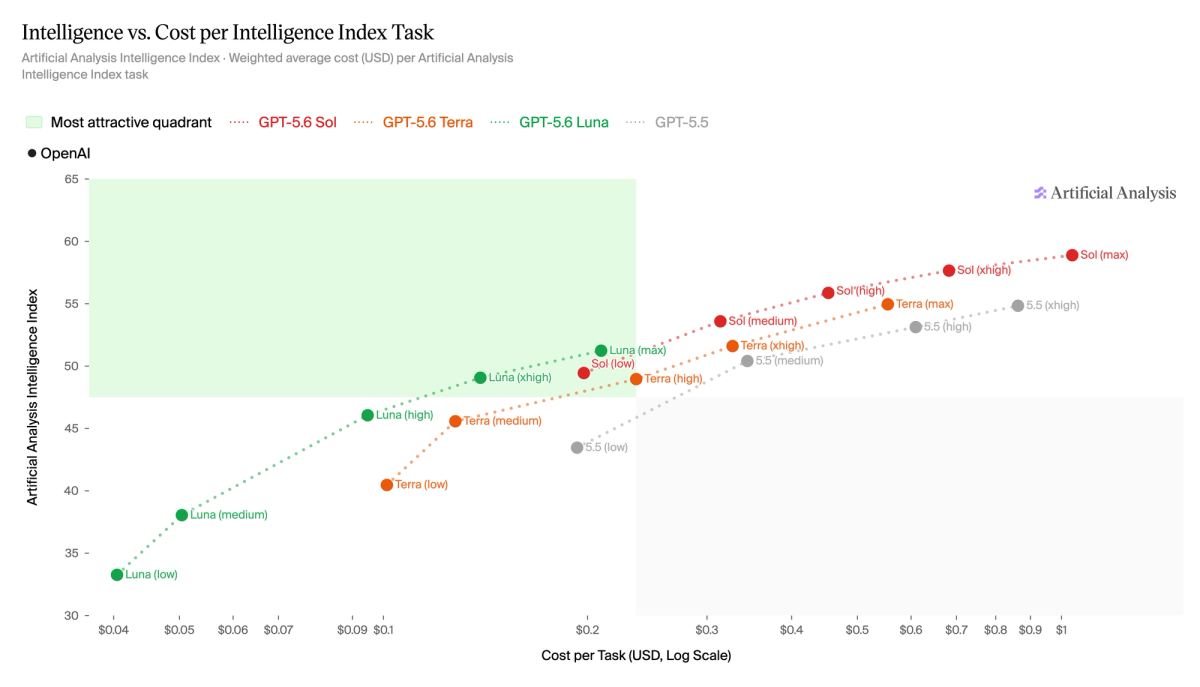
GPT-5.6 Terra is positioned as the balanced model in the series, sitting squarely between the high-performing Sol and the ultra-cost-efficient Luna. For many everyday coding tasks, general reasoning, and agentic workflows where a strong performance-to-cost ratio is key, Terra is an immediate contender. It offers robust capabilities at roughly half the cost of Sol. This makes it an attractive option for scoped implementations and initial passes on review tasks, where you need a reliable output without the full horsepower (and price tag) of the flagship model.
Consider a scenario where an agent is tasked with generating boilerplate code or refactoring a well-defined module. Sol might be overkill, driving up operational costs unnecessarily. Terra, in such cases, provides a 'cheaper lane' for testing and deployment, delivering strong results without breaking the bank. The data suggests Terra's capabilities are more than sufficient for a substantial portion of development work, making it a critical tier for optimizing budgets.
Luna: The Efficiency Champion
Then there's Luna, the fastest and lowest-cost tier in the GPT-5.6 family. Luna is not about complex reasoning or deep architectural judgment; it's about sheer efficiency for high-volume, low-reasoning tasks. Priced significantly lower—around $1 per 1 million input tokens and $6 per 1 million output tokens compared to Terra's $2.50/$15 and Sol's $5/$30—Luna is designed for situations where speed and cost are the primary constraints.
Where does Luna shine? Think top-of-funnel agent work: summarizing long documents, labeling data points, extracting specific information, or drafting initial scaffolds for code. If a task primarily involves pattern recognition, translation, or generating predictable text structures, Luna offers an incredible amount of work done per dollar. Benchmarks indicate that Luna can deliver roughly 24 benchmark points per estimated API dollar, showcasing a substantial performance-per-dollar advantage—up to 5x to 7.5x more measured performance per dollar than Sol. This makes it invaluable for pre-processing, data enrichment, or any task where a cheap first pass can either provide standalone value or significantly reduce the load before escalating to a Terra or Sol model.
Beyond List Prices: The Impact of Prompt Caching
One critical factor that profoundly influences the effective cost of using these models is prompt caching. OpenAI has made prompt caching more predictable in GPT-5.6, including explicit cache breakpoints and a guaranteed 30-minute minimum cache life. For developers, this is a game-changer. The actual price paid for API calls, especially for repeated context, can be 60-80% cheaper than the provider's list price.
For agentic workflows that repeatedly access the same repository files, documentation, or other contextual data, prompt caching drastically reduces costs. An agent that reads the same codebase for hours will appear significantly less expensive once cache reads are effectively working. This means that when evaluating the models, it's not enough to look at the token price alone; the cost per solved task and the efficiency gained from caching for repetitive operations become the true metrics of success.
Furthermore, external routing services like OpenRouter add another layer of optimization. They can route your request to different hosting providers based on modes like Balanced (optimizing price and speed), Nitro (fastest), or Exacto (highest tool-calling accuracy). This dynamic routing, combined with proactive error handling and retries, ensures that developers can achieve optimal performance and reliability without needing to manage multiple provider integrations themselves.
Strategic Tier Selection for Agentic Workflows
- The most effective strategy for building with GPT-5.6 involves a multi-tiered approach, particularly for complex agentic systems. Imagine an AI coding agent:
- Luna for Initial Triage: An initial phase might use Luna to quickly parse a user request, extract key entities, or generate a high-level task outline. Its low cost and speed make it perfect for this top-of-funnel work.
- Terra for Implementation: For the actual code generation or initial refactoring of a specific module, Terra could be employed. It provides the necessary reasoning and coding capabilities without incurring Sol's premium cost, especially for scoped and well-defined tasks.
- Sol for Complex Problem Solving or Review: If the agent encounters a particularly thorny architectural decision, a cross-file refactoring challenge, or needs to perform a deep, comprehensive code review, it can escalate to Sol. Sol's superior long-horizon capabilities would be leveraged only when truly necessary, ensuring that the highest cost model is used judiciously.
This tiered routing, coupled with effective prompt caching, allows engineering teams to optimize both the performance and the cost of their AI-powered applications. It's about moving away from a 'one model fits all' mentality and embracing a more granular, intelligent approach to resource allocation.
Ultimately, GPT-5.6's tiered architecture empowers developers to build more cost-efficient and performant AI systems. The key is to understand the strengths and weaknesses of each tier, measure actual cost per solved task rather than just per token, and strategically apply the right model to the right problem. The year 2026, as some predict, is indeed becoming the year of AI quality—and a significant part of that quality will be derived from intelligent resource management and cost optimization.