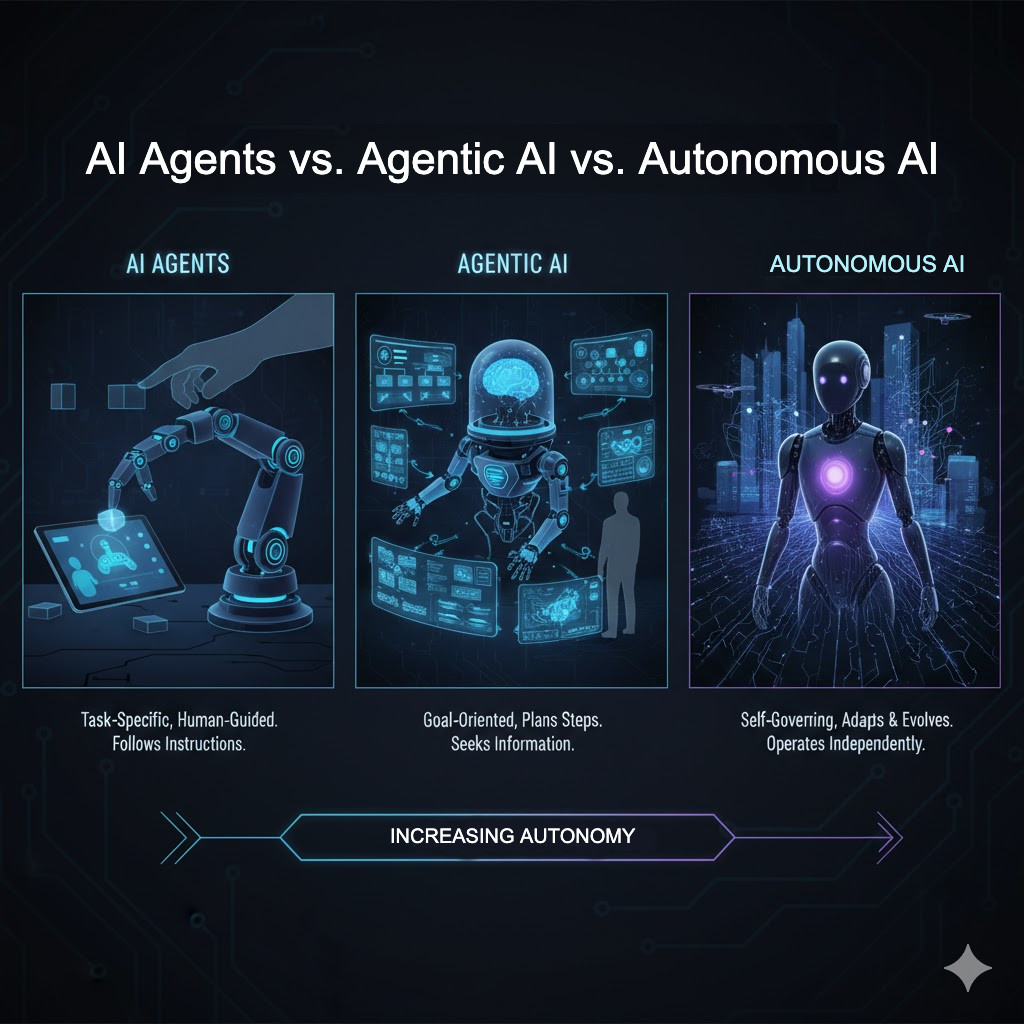
Navigating the Agentic Frontier: A Developer's Perspective on Autonomous Systems
In 2026, the AI landscape feels considerably different from even a year or two ago. We're moving past the novelty of single-prompt Large Language Models (LLMs) and chatbots. The real architectural evolution is happening with agentic systems—software designed to operate autonomously, pursue complex goals, and adapt to dynamic environments. As developers, this isn't just an interesting research topic; it's a critical layer we're integrating into our applications.
What Defines an AI Agent?
An AI agent is, at its core, a piece of software capable of perceiving its environment, reasoning about its observations, making decisions, and performing actions to achieve a specified objective, all with a meaningful degree of autonomy. This isn't just about a model generating text; it's about a system that actively engages with the world.
Several components are crucial to this definition:
Autonomy: Agents can execute a sequence of steps without requiring human approval at every turn. A system that pauses for confirmation on every action isn't an agent; it's an interactive UI.
Goal-driven Behavior: Agents aren't just reacting to the last input. They have an overarching objective and actively track progress towards that end state, organizing their behavior around achieving it.
Interaction with Environment: This is where agents move beyond a chat window. They read files, call APIs, execute code, query databases, send messages, or navigate interfaces, having real-world effects.
Decision-Making: Based on the current state, its memory, and its understanding of the goal, an agent determines the next best course of action. It selects from options rather than following a rigid, predefined script.
To put it simply, an AI agent operates in a continuous loop: Perceive → Reason → Act → Reflect. It observes the environment (user input, system state, available tools, memory), plans and makes decisions (often leveraging an LLM), executes actions (calls tools, updates memory, triggers workflows), and then evaluates the outcome to adjust future decisions or plans. This iterative process is what allows agents to adapt and improve.
It's important to clarify what AI agents are not. They are not merely chatbots with memory—those still depend on human direction for every real-world action. They are not standard rule-based automation pipelines like a Zapier workflow; those lack the ability to reason or adapt to unexpected events. And they are certainly not just an LLM prompt with a long system message instructing it to "act like a project manager"; the agentic property emerges from the underlying infrastructure providing tools, memory, and the continuous loop of action and observation.
Why Agentic Frameworks are Essential
While it's theoretically possible to build an agent from scratch, the complexities involved quickly become unmanageable. This is where agentic frameworks become indispensable. They provide the infrastructure necessary to build, run, and control AI agents at scale, transforming experimental agent builds into maintainable software.
- Frameworks offer several critical capabilities:
- Orchestration: This is about controlling how agents are sequenced, coordinated, or allowed to collaborate. As tasks grow more complex, managing the flow between different agent capabilities or even multiple specialized agents becomes paramount. Some frameworks, for instance, utilize graph-based orchestration, defining explicit paths agents can follow, which offers maximum control over execution flow.
- Tools: Agents are only as powerful as their ability to interact with the real world. Frameworks define how agents can securely and effectively interact with external systems like APIs, databases, web search, or code execution environments. This allows them to perform actions beyond simple language generation.
- Memory: For agents to operate autonomously and coherently over time, they need to retain and retrieve information across steps, sessions, and even long-running tasks. Frameworks provide mechanisms for persistent memory, allowing agents to maintain context, personalize interactions, and improve performance based on past experiences.
Beyond these core capabilities, frameworks facilitate several advanced features vital for production-grade applications:
Multi-agent Coordination: Many complex problems are best solved by specialized agents collaborating. Frameworks enable communication, planning, and task distribution among multiple agents.
Human-in-the-Loop (HITL) Checkpoints: For high-stakes or sensitive tasks, frameworks allow for intentional pause points where a human can review an agent's proposed action before it executes.
Observability, Control, and Reproducibility: In development and production, understanding what an agent is doing, guiding its behavior, and being able to re-run an agent with the same inputs to get consistent results are non-negotiable.
Prominent frameworks like LangChain, AutoGen, CrewAI, and LangGraph have emerged, each offering different strengths for single-agent or multi-agent orchestration, tool integration, and data retrieval. Their value lies in abstracting away much of the underlying complexity, accelerating development, and providing a structured approach to building reliable autonomous systems.
The Importance of Robust Data Infrastructure
It’s worth noting that even the most sophisticated agentic framework is only as good as the data infrastructure supporting it. Agents rely on a continuous flow of high-quality data to perceive their environment, learn from context, and execute decisions efficiently. Without a robust backend, agents can suffer from bottlenecks, memory loss, and latency issues.
This is where battle-tested open-source technologies like Apache Kafka for real-time data ingestion, Apache Cassandra for scalable data storage, PostgreSQL for relational data, and OpenSearch for powerful search capabilities become the backbone. They provide the scalable, efficient, and reliable foundation necessary for agents to perform optimally, especially in dynamic, real-world environments.
Practical Concerns and Guardrails
While the potential of agentic AI is immense, a pragmatic developer understands the risks. Hallucinations, tool misuse, prompt injection vulnerabilities, and cascading failures in multi-agent systems are real threats that need to be addressed proactively. Deploying agents blindly is irresponsible.
Good deployments demand robust guardrails:
- Least-privilege permissions: Agents should only have access to the resources and actions strictly necessary for their tasks.
Full action logging: Comprehensive logs of all agent actions and decisions are crucial for debugging, auditing, and understanding system behavior.
Human approval for high-risk tasks: Implement HITL checkpoints for actions that have significant consequences.
- Kill switches: The ability to immediately halt an agent or agent system is a necessary safety net.
Conclusion
The move towards agentic AI is more than a trend; it's a fundamental shift in how we conceive and build software. For developers, understanding the principles behind AI agents and how to leverage agentic frameworks is becoming a core competency. These systems promise to automate complex workflows, provide proactive intelligence, and interact with our digital and physical worlds in unprecedented ways. Our role is to build them not just with capability, but with reliability, scalability, and safety at the forefront of our design.