Navigating the Autonomous Frontier: Agentic AI in Software Engineering
For the past few years, our engagement with AI in software development has largely been... co-piloted. These tools, undeniably powerful, augment our capabilities, taking boilerplate tasks, suggesting completions, and even drafting functions. Many of us have felt the genuine leap in output, a sense of enhanced agility. Yet, this era, as productive as it has been, is giving way to something far more autonomous: Agentic AI. The shift isn't merely incremental; it represents a fundamental restructuring of the Software Development Life Cycle (SDLC) itself, moving the focus from raw code generation to contextual understanding and autonomous problem-solving. This isn't about AI helping us write code faster; it's about AI taking on entire, complex workflows on our behalf.
Understanding Agentic Systems
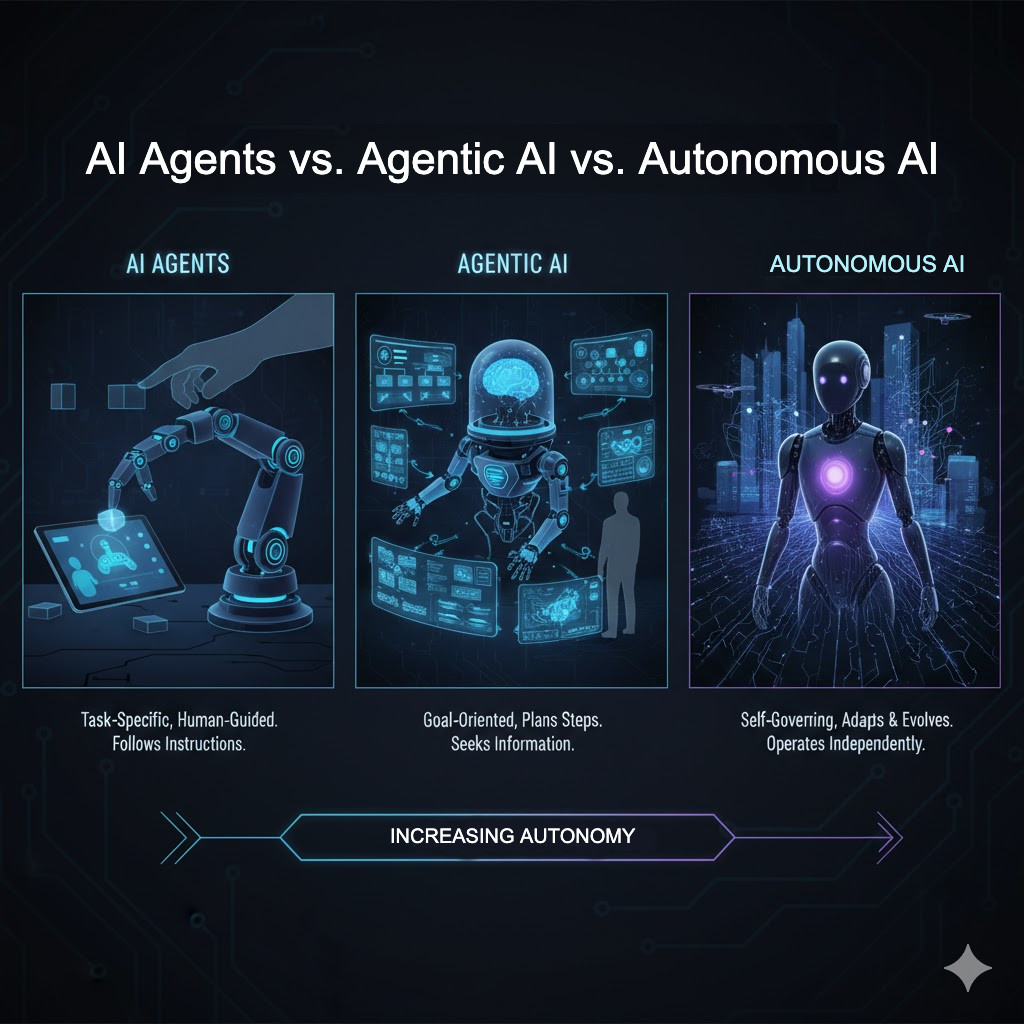
At its core, an artificial intelligence (AI) agent is a system or program designed to autonomously perform tasks. This isn't just about natural language processing. These agents can perceive their environment, process information, make decisions, interact with external systems, and execute actions. They're capable of designing their own workflows and utilizing available tools to achieve a user's objective.
The underlying 'agentic architecture' defines how these frameworks are structured, enabling the automation of AI models within a larger system. When multiple agents collaborate, we're talking about a multi-agent system – a collective intelligence tackling more complex problems than a single agent could manage alone.
Beyond the Copilot Paradigm
The distinction from copilots is critical. While a copilot assists in a prompt-response cycle, agents are designed for sustained, multi-step operations. We're moving past short interactions to systems that can run for minutes or hours. This means AI can now handle entire implementation workflows: writing tests, debugging failures, generating documentation, and even navigating complex codebases autonomously. This isn't just a helper; it's an AI teammate. The concept of Agentic Software Engineering (SE 3.0) positions AI agents as autonomous partners performing tasks traditionally reserved for human developers.
For many seasoned developers, there's a nostalgic pang for the 'long way round' – the deep dives into documentation, the late-night searches, the serendipitous discovery of new problem classes. That journey was often the point, fostering a deep sense of ownership and achievement. Agentic AI, by taking on more of this autonomous problem-solving, inevitably reshapes that experience. The question becomes less about how we solve a specific coding problem and more about what problem we instruct the agent to solve and how we oversee its progress.
The Productivity Paradox and Its Resolution
Initial observations around AI and developer productivity presented what some termed a 'productivity paradox.' Early studies even suggested developers took longer on tasks with AI tools, citing the overhead of directing, reviewing, and correcting AI output. This finding surprised many.
However, the narrative quickly evolved. By early 2026, a crucial follow-up emerged: developers were increasingly unwilling to participate in studies without AI access. This isn't just preference; it’s a dependency, suggesting the initial 'longer duration' was a lower bound, and the real-world uplift, especially on appropriate tasks and with refined workflows, is substantially higher. The lesson here is clear: productivity gains are task-dependent and context-dependent. They only truly materialize when teams structure their workflows effectively around these powerful new tools. This is the essence of an 'Agentic SDLC'.
Another study, covering thousands of developers, reinforced this: despite high AI coding assistant usage, many organizations weren't seeing measurable improvements in delivery velocity. The root cause? Superficial AI usage – mostly autocomplete – with advanced agentic capabilities largely untapped. The gap between what's possible and what's practiced remains significant.
The Rise of Agentic Frameworks
To bridge this gap and harness the true power of agentic AI, developers need the right infrastructure. This is where 'agentic frameworks' come into play. These are the building blocks, the software toolkits that simplify the creation, deployment, and management of autonomous AI agents. They provide pre-built components and abstractions that streamline the development process, abstracting away much of the underlying complexity of orchestrating multiple AI models and tools.
The emergence of numerous options for these frameworks indicates a maturing ecosystem. These platforms are crucial for shaping the workflow structure, allowing us to automate complex sequences of operations that would be cumbersome to manage manually, especially when leveraging advanced techniques like Agentic RAG for sophisticated information retrieval from diverse sources.
Implications for Software Development
The implications for software development are profound. The traditional SDLC is being 'restructured around context, not code.' This means our role as developers is shifting. We're transitioning from primarily coding solutions to designing intelligent systems, defining high-level goals, and orchestrating teams of agents. We become more akin to system architects and project managers for AI-driven workflows.
Industry workshops, such as 'AgenticDev: Agentic AI for Software Development' at ASE 2026, demonstrate the academic and industry focus on this transition. The focus is on integrating AI into every stage, from requirements gathering to deployment and maintenance. This calls for a developer's guide to agentic AI systems and observability, highlighting the shift from deterministic software to a more probabilistic world.
This also brings in the challenge of 'PromptOps & Vibe Coding' – the art and science of effectively communicating with and guiding these autonomous agents, ensuring they align with our intentions and project goals. It's less about writing perfect code and more about writing perfect prompts and designing robust feedback loops.
Challenges and Considerations
With greater autonomy comes greater responsibility. The topic of 'AI agent governance' is paramount. We need clear processes, standards, and guardrails to ensure these agentic systems are safe, ethical, and perform as expected. This involves understanding evolving regulations and building robust AI governance frameworks. The 'TRUST: Trustworthy & Responsible Autonomous Systems' workshop at ASE 2026 emphasizes the critical importance of these aspects.
Ensuring transparency, explainability, and the ability to audit agent decisions will be key. Debugging an agent's 'thought process' or correcting a multi-step autonomous workflow introduces new layers of complexity compared to debugging a traditional code bug. Observability for these systems is no longer a luxury but a necessity.
The Road Ahead
The future of software development with agentic AI is less about replacing developers and more about augmenting our reach and transforming our roles. We are moving towards a paradigm where AI agents act as extensions of our intent, handling complexity and scale that would be unmanageable otherwise. The challenge ahead is to master the orchestration of these autonomous entities, to design robust agentic architectures, and to implement the necessary governance to ensure these powerful systems deliver on their promise responsibly.
It’s an exciting, albeit complex, frontier, demanding a shift in mindset from imperative coding to declarative goal-setting and strategic system design. For those of us building the future, understanding and engaging with agentic AI isn't just an option—it's becoming a core competency.