Orchestrating Autonomy: Agentic AI in Modern Software Engineering
Current AI tools, like our familiar code copilots and chatbots, have undeniably boosted productivity. They're excellent assistants, providing suggestions, generating boilerplate, or answering quick questions. However, the next evolutionary leap in AI for software development isn't just about assistance; it's about autonomy. We're talking about Agentic AI, systems designed to perceive, reason, act, and reflect with a level of independence that significantly shifts how we approach complex, multi-step engineering challenges.
What is Agentic AI, From a Developer's Perspective?
Forget the reactive AI models that wait for your next prompt. Agentic AI platforms empower AI systems to define goals, plan sequences of actions, execute those actions across diverse tools and data sources, and adapt their approach based on real-time feedback. Imagine telling a system, "Prepare the quarterly sales report," and it autonomously handles data extraction from your CRM, trend analysis, visualization, drafting insights, and final formatting – all without you scripting each step. This is the essence of agency: the AI acts on its own initiative within predefined boundaries.
The core distinction lies in their architecture and operational cycle. Unlike traditional static automation or even advanced copilots, agentic systems embody a "perceive, reason, act, reflect" (PRAR) loop:
Perceive: They observe their environment, understanding context, user input, system state, and available tools.
Reason: They plan, make decisions, and select actions, often leveraging large language models (LLMs) for complex logic.
Act: They execute chosen actions, interacting with APIs, databases, or triggering workflows.
Reflect: They evaluate outcomes, learn from successes or failures, and adjust future plans or prompts for improvement.
This continuous feedback loop allows them to self-correct and pursue overarching goals with far less explicit human direction. They aren't just following a rigid script; they're making choices.
Building Blocks of Autonomous Systems: Components and Frameworks
- For a system to genuinely exhibit agentic behavior, it needs more than just a powerful LLM. It relies on several core capabilities:
- Goal-Directed Behavior: The AI works towards specific, high-level objectives rather than just executing isolated commands.
- Autonomous Decision-Making: It can make choices on how to achieve goals, resolving ambiguities or adapting to challenges without human intervention.
- Multistep Reasoning and Planning: It can decompose complex objectives into logical sequences of dependent tasks.
- Adaptability to Changing Context: The system can adjust its strategy dynamically when circumstances shift.
- Interaction with Multiple Systems/Tools: It seamlessly connects and orchestrates actions across various APIs, databases, and applications in your tech stack.
For developers, orchestrating these components from scratch is a significant undertaking. This is where agentic frameworks become indispensable. Frameworks like LangChain and AutoGen are rapidly becoming foundational layers in modern application architecture. They provide the necessary infrastructure to build, run, and control AI agents at scale, offering:
Orchestration: Managing how agents are sequenced, coordinated, or allowed to collaborate (e.g., graph-based orchestration, where agents and tools are nodes in a defined flow).
Tools: Defining how agents interact with external systems – essentially, giving the AI "hands" to manipulate the world through APIs or other interfaces.
Memory: Enabling agents to retain and retrieve information across steps, sessions, or even long-running processes, giving them context and preventing repetitive work.
These frameworks facilitate crucial aspects like multi-agent coordination (where specialized agents work together) and, critically, Human-in-the-Loop (HITL) checkpoints. This last point is vital; it ensures that despite the autonomy, a developer can insert intentional pause points to review an agent's planned actions or outcomes before they proceed.
A conceptual look at how an agent might use tools within a framework:
# Pseudo-code for an agent's PRAR cycle using a conceptual framework
class SoftwareAgent:
def __init__(self, name, tools, memory, goal):
self.name = name
self.tools = tools # e.g., git_tool, ide_tool, security_scanner_tool
self.memory = memory
self.goal = goal
self.current_plan = [] def perceive(self, environment_state, human_input=None):
# Observe changes, gather data from memory, external systems
print(f"[{self.name}] Perceiving environment...")
context = self.memory.retrieve_relevant_info()
if human_input:
context.append(f"Human instruction: {human_input}")
return context
def reason(self, context):
# Use LLM or internal logic to plan based on context and goal
print(f"[{self.name}] Reasoning on context: {context[:50]}...")
# A real agent would call an LLM here to generate a plan
if not self.current_plan:
self.current_plan = self._llm_generate_plan(self.goal, context)
print(f"[{self.name}] Generated new plan: {self.current_plan}")
return self.current_plan.pop(0) if self.current_plan else None
def act(self, action_item):
# Execute an action using available tools
print(f"[{self.name}] Executing action: {action_item}")
if "write_code" in action_item:
# self.tools["ide_tool"].write_code(action_item["code_details"])
return {"status": "success", "output": "Code written."}
elif "run_tests" in action_item:
# result = self.tools["ide_tool"].run_tests()
return {"status": "success", "output": "Tests passed."}
elif "scan_security" in action_item:
# report = self.tools["security_scanner_tool"].scan_repo()
return {"status": "success", "output": "Security scan completed."}
else:
return {"status": "fail", "output": "Unknown action."}
def reflect(self, previous_action, outcome):
# Evaluate outcome and update memory/plan
print(f"[{self.name}] Reflecting on outcome of '{previous_action}': {outcome}")
self.memory.store_feedback(previous_action, outcome)
if outcome["status"] == "fail":
print(f"[{self.name}] Action failed. Adjusting plan...")
# A real agent would trigger re-planning or seek human help
self.current_plan = [] # Force re-plan
def _llm_generate_plan(self, goal, context):
# This would be an LLM call to break down the goal into steps
# For demonstration, a static plan is returned:
if "security_audit" in goal:
return [
{"action": "scan_security"},
{"action": "review_report"},
{"action": "create_fix_pr"}
]
elif "develop_feature" in goal:
return [
{"action": "write_code", "code_details": "implement X"},
{"action": "run_tests"},
{"action": "refactor_code"},
{"action": "create_pr"}
]
return [{"action": "default_task"}]
# This snippet demonstrates the PRAR cycle conceptually. It showcases how an agent might
# perceive, reason (planning steps), act (using predefined tools), and reflect on outcomes
# to adjust its strategy. Agentic frameworks abstract much of this complexity.
Agentic AI in Practice: Reshaping Development Workflows
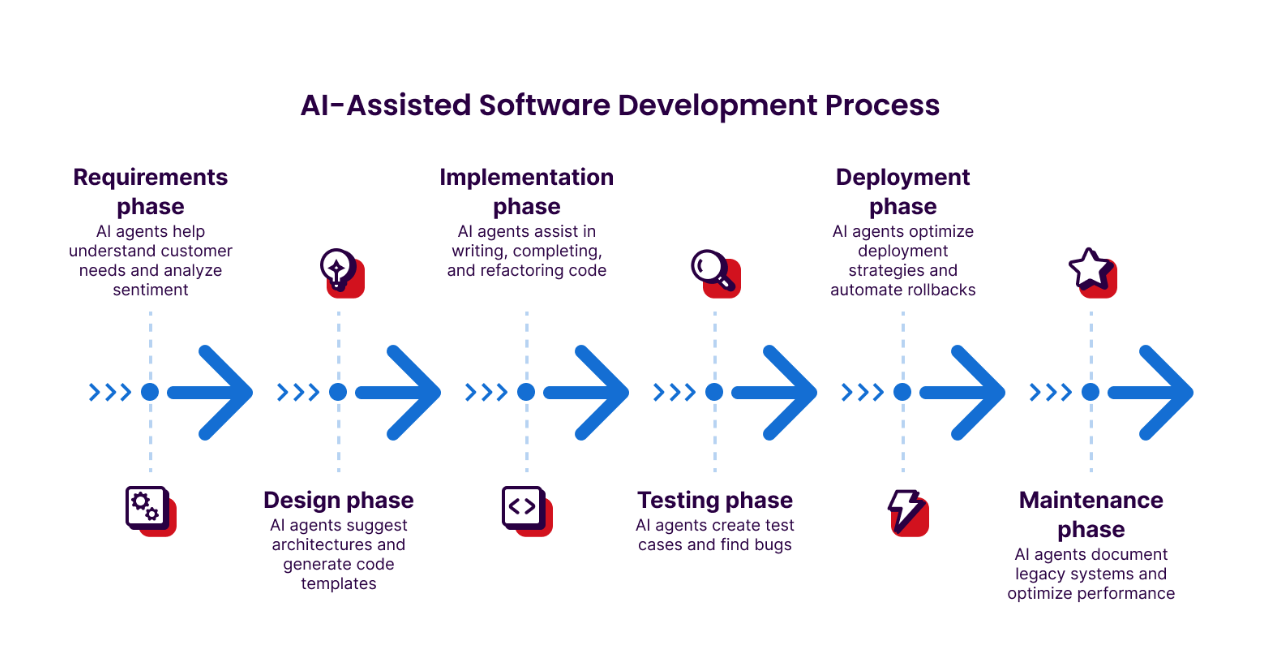
- The practical applications of agentic AI across the software development lifecycle are extensive, moving far beyond mere code suggestions:
- Agentic AI Security Tools: These autonomous agents actively monitor codebases and environments in real-time. They don't just flag vulnerabilities; they identify anomalous behavior, correlate threat intelligence, and can recommend or even take proactive actions to mitigate risks throughout the CI/CD pipeline. This is a significant upgrade from traditional static scanners.
- Advanced Code Assistants and "Live Coding" AI: Current code assistants are good, but agentic versions promise to be profoundly more capable. They can interact directly with your IDE, review entire codebases, and perform multi-step tasks like running comprehensive test suites or executing complex refactoring operations, all based on natural language prompts. Think of an AI that not only suggests a fix but applies it, runs regression tests, and drafts a commit message.
- Code Review and Refactoring Automation: Beyond simple linting, AI-powered review agents can analyze code submissions, understand architectural patterns, and suggest improvements based on project conventions and best practices learned from vast datasets. They can accelerate review cycles and enforce quality standards more consistently across large teams.
- Testing, Debugging, and Quality Automation: Agentic tools are automating the creation, execution, and maintenance of tests across application layers. Imagine an agent that dynamically generates integration tests based on recent code changes, executes them, analyzes failures, and even attempts to self-heal or suggest targeted debugging steps.
These tools are not just improving individual tasks; they are orchestrating workflows. An agentic platform can connect to your version control, issue tracker, build system, and deployment pipelines to manage a feature's lifecycle from initial requirement analysis to deployment and monitoring.
The Developer's Role: Remaining the Architect, Not Just the Coder
A critical aspect of agentic AI is that "humans remain in charge." This isn't about replacing developers; it's about augmenting our capabilities and freeing us from repetitive, lower-level tasks. As a senior engineer, my focus shifts from meticulously scripting every step to defining high-level goals, establishing clear guardrails, and validating outcomes. We become the managers of intelligent systems, providing them with context, desired objectives, and the tools they need to succeed.
Agentic frameworks are instrumental here. They offer:
Human-in-the-Loop (HITL) Checkpoints: Explicit points where a human can pause the agent, review its proposed actions, or provide additional guidance before it proceeds. This maintains control and trust.
Observability: The ability to see what an agent is doing, why it's making certain decisions, and the state of its internal reasoning process. Without this, debugging and auditing autonomous systems would be a nightmare.
Control and Reproducibility: The capacity to guide agent behavior and, crucially, to re-run an agent and expect consistent, predictable results—a fundamental requirement for reliable software.
We're moving into an era where our expertise in system design, robust architecture, and defining clear problem statements becomes even more paramount. We're training and managing digital team members that can execute, but the strategic vision and ultimate responsibility still rest with us.
Practical Considerations and the Road Ahead
Adopting agentic AI isn't without its challenges. The complexity of debugging multi-agent systems, ensuring robust error handling, and managing the "hallucination" tendencies of underlying LLMs are real concerns. Data privacy and governance controls for AI-generated code also require careful consideration.
However, the benefits of reduced manual effort, improved consistency, faster delivery cycles, and enhanced code quality are too significant to ignore. The most effective approach is to integrate these agentic workflows into existing tools and workspaces, gradually introducing autonomy where it provides the most value and can be closely monitored.
Agentic AI is rapidly evolving from a theoretical concept to a critical layer in our software infrastructure. It represents a fundamental shift in how we interact with AI, transforming it from a passive assistant into an active, goal-driven participant in the development process. As developers, understanding these systems, leveraging agentic frameworks, and mastering the art of managing autonomous agents will be key skills in the coming years. We are not just building software; we are building systems that can build, secure, and maintain software themselves, under our expert supervision.