Orchestrating Autonomy: The Developer's Guide to Agentic AI
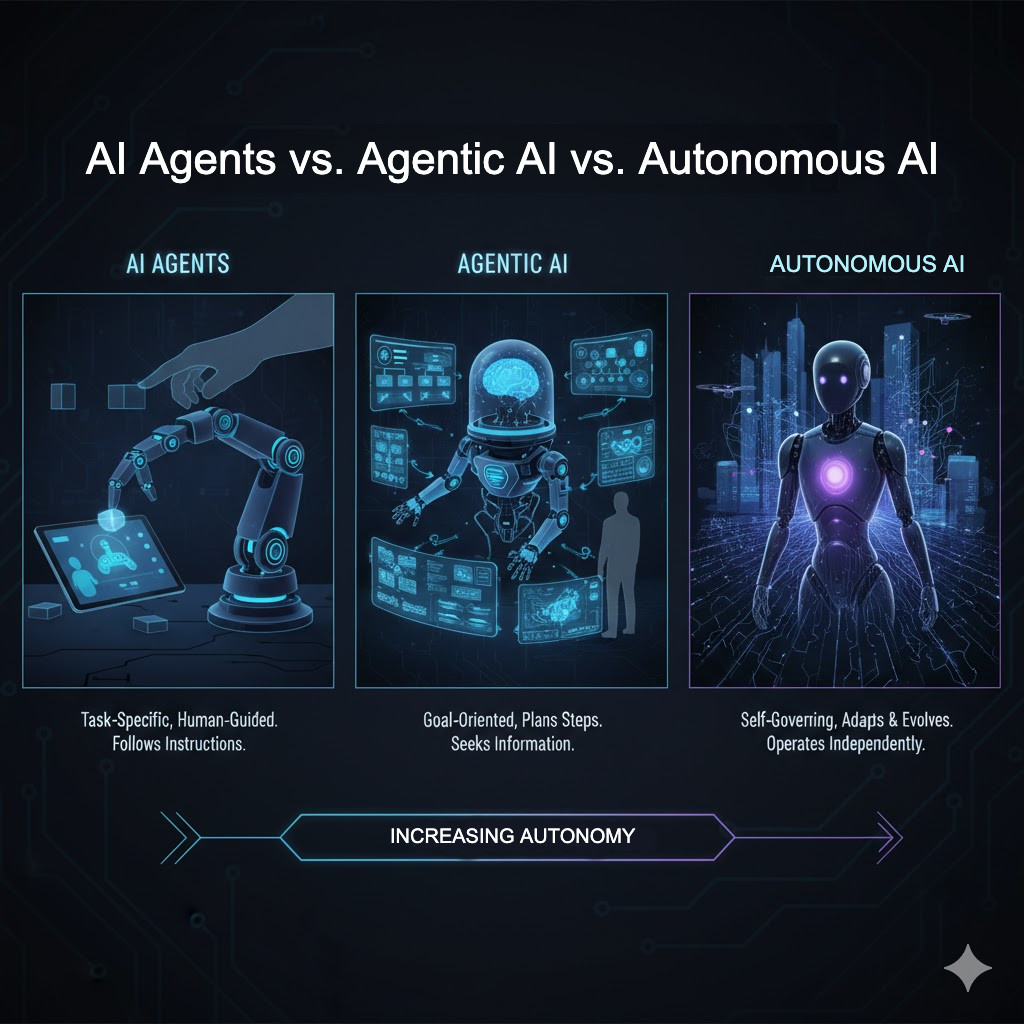
The landscape of software development is in constant flux, but the current wave of Agentic AI and autonomous agents presents a fundamental shift. For years, we've integrated AI as a tool – smart linters, sophisticated search, predictive analytics. Now, we're talking about systems that don't just assist but act with a degree of autonomy, setting goals, planning, executing, and adapting without constant human intervention. This isn't just about faster code generation; it's about a different way of building software, and it demands our attention.
What is Agentic AI and Why Developers Should Care
At its core, Agentic AI refers to AI systems engineered to behave like autonomous agents. Think beyond a coding assistant that suggests a line; consider an agent that takes a user story, designs a plan to implement it, writes the code, runs tests, fixes errors, and then proposes a deployment, all while reasoning about constraints and adapting to new information. Its workflow looks less like a single prompt-response and more like a continuous loop: Goal → Plan → Execute → Adapt.
For developers, this isn't a curiosity; it's a paradigm shift. We move from dictating every step to designing the intelligent systems that perform those steps. Our focus expands to:
System Behavior Design: Crafting how autonomous entities behave, collaborate, and interact within a larger system.
Reliability and Observability: Ensuring these agents operate predictably, with clear audit trails and mechanisms to monitor their actions.
Guardrails and Governance: Establishing robust controls, ethical boundaries, and security protocols, because agents can take significant actions, potentially with real-world consequences.
Industry Adoption: McKinsey's 2025 Outlook
The buzz around Agentic AI isn't purely theoretical. McKinsey’s 2025 reports indicate a strong interest, with 88% of organizations leveraging AI in at least one business function. More specifically, 39% are actively experimenting with Agentic AI. However, there's a clear scaling gap: only around 23% are actively scaling it, and deep adoption within a single function rarely exceeds 10%. This suggests we're still in the early days of widespread practical deployment, with many teams still figuring out how to move beyond experimentation.
Where these agents are showing promise is often in areas closely tied to developer workflows: software engineering, IT, and manufacturing. These functions are reporting the most significant cost benefits and efficiency gains from AI integration. High-performing companies are allocating a substantial portion (20%+) of their digital budgets to AI, signaling a move towards deep integration rather than superficial add-ons.
The Evolving Role of the Developer
This doesn't mean developers are being replaced; it means our roles are evolving. The manual, repetitive coding tasks are ripe for automation by agents. Tools like GitHub Copilot are already saving developers 30-50% of time on boilerplate, unit tests, and documentation. The future developer will increasingly spend time on:
Defining Goals and Constraints: Clearly articulating what needs to be built and the boundaries within which agents must operate.
Architectural Design: Crafting high-level system designs, data flows, and integration points, areas where human judgment on business problems is irreplaceable.
Tool Selection and Integration: Choosing the right AI agents and ensuring they can effectively interact with existing repositories, CI/CD pipelines, and other APIs.
Orchestration and Monitoring: Overseeing the agents, evaluating their output, and stepping in when complex trade-offs or critical decisions are required.
Prompt Engineering: Guiding the agents effectively, not just with simple prompts, but with structured, persistent context.
Practical Interaction: Structuring Your Agentic Workflow
Engaging with Agentic AI effectively demands a structured approach, moving beyond single-shot prompts. The key is providing persistent context and clear instructions for your AI partners. Consider two essential files within your codebase that act as your communication channel:
prompt.md - Your Coding Intent Document
This file articulates the project's goals, requirements, and specific tasks you want the agents to undertake. It's your blueprint.
# Project Goal
Develop a secure RESTful API for a new inventory management system.## Core Requirements
- **Endpoints**: CRUD operations for `products` and `warehouses`.
- **Authentication**: Implement OAuth2/JWT for all protected routes.
- **Database**: PostgreSQL. Define schemas for `products` (id, name, description, quantity, price, warehouse_id) and `warehouses` (id, name, location).
- **Technology Stack**: Python with FastAPI, SQLAlchemy ORM, PostgreSQL.
## Specific Tasks for Agent
1. **Database Schema**: Generate SQL DDL for `products` and `warehouses` tables, including foreign key constraints.
2. **API Scaffolding**: Create basic FastAPI routes and models for the specified entities.
3. **Authentication Module**: Implement OAuth2 bearer token authentication and JWT handling.
4. **Unit Tests**: Generate initial unit tests for core API endpoints and authentication logic.
5. **Documentation**: Generate OpenAPI schema based on the implemented API.
AGENTS.md - AI Behavior Instructions
This file provides persistent behavioral guidelines for your AI coding assistants, ensuring consistency, quality, and adherence to project standards. Research indicates that structured agent instructions can significantly reduce hallucinations and improve code quality.
## General Agent Instructions
- **Coding Style**: Adhere to PEP 8 standards for Python code.
- **Error Handling**: Implement comprehensive error handling; return standardized JSON error responses with clear status codes.
- **Security**: Prioritize security best practices (e.g., input validation, parameterized queries, least privilege).
- **Documentation**: Generate Google-style docstrings for all functions, classes, and modules.
- **Feedback Loop**: If tests fail or linting issues arise, analyze the output, propose a fix, and re-attempt the task until successful.
- **Tool Usage**: Prefer `pytest` for testing, `ruff` for linting, `black` for formatting, `git` for version control.## Specific Agent Roles
- **Database Agent**: Focus on efficient SQL generation, schema migrations (if applicable).
- **API Agent**: Ensure RESTful principles, correct HTTP methods, and appropriate response structures.
- **Security Agent**: Focus on robust authentication, authorization, and data integrity checks.
- **Testing Agent**: Aim for high code coverage, test edge cases and error conditions.
## Constraints
- **No LLM-specific libraries**: Utilize standard Python, FastAPI, SQLAlchemy ecosystem libraries.
- **Performance Target**: API response times under 150ms for typical CRUD operations on single entities.
This approach transforms a simple prompt into a persistent, contextualized conversation with an intelligent system. It's about engineering the interaction, not just the code.
Ethical and Governance Challenges
With agents taking actions, the stakes are higher. We must actively address:
- Security Vulnerabilities: Agents might inadvertently introduce security flaws or expose sensitive data if not properly constrained and monitored.
Auditability: Understanding why an agent made a particular decision or wrote a specific piece of code is crucial for debugging and compliance.
Cost Controls: Unmonitored agents could incur significant computational costs. Effective governance requires tracking and optimizing resource usage.
Hallucinations and Bias: Agents, like any AI, can produce incorrect or biased outputs. Human oversight is essential to catch and correct these.
- Accountability: When an autonomous system makes an error, who is responsible? Defining clear lines of accountability is paramount.
Workflow Redesign and Scaling
The real impact of Agentic AI isn't in isolated tasks; it's in redesigned workflows. Simply plugging an agent into an existing process won't unlock its full potential. Organizations seeing success are rethinking their entire development lifecycle: how requirements are gathered, how designs are iterated, how code is reviewed, tested, and deployed. This includes developing robust internal frameworks for managing agents, ensuring security, and integrating them seamlessly into existing CI/CD pipelines.
Scaling Agentic AI means building internal competencies around prompt engineering, agent orchestration, and the governance frameworks that enable safe, efficient operation across an enterprise. It's an investment in process and people, not just technology.
The Road Ahead
Agentic AI is not a fad; it's a direction. The agents of today, while powerful, are still relatively nascent. We can expect them to become more sophisticated, capable of handling increasingly complex, multi-stage reasoning and task execution. This will push developers further into the role of system architects and intelligence orchestrators. The most successful teams will be those that embrace this shift pragmatically, understanding both the immense potential for automation and the critical, irreplaceable role of human judgment, creativity, and ethical oversight. Prepare to design the intelligence, not just write the lines.